Developer productivity metrics for AI-assisted teams.
No single number measures developer productivity: DORA covers delivery, SPACE five dimensions of how people work, and the DX Core 4 rolls both into four. On an AI-assisted team, add what each engineer's coding agents cost and whether their sessions end in merged pull requests.
13/14 AI Adoption55 PRs Merged10.3h Median AI Time
13/14
AI Adoption▲ 3
55
PRs Merged▼ 8
10.3h
Median AI Time▼ 3.5h
57.2h
Build Hours▲ 20.3h
Agents Ran
Planning43
Implementation49
60300
Aug 14Aug 21Aug 28Sep 4
AI Plan Stack
Top Dev46
p256
80400
Aug 14Aug 21Aug 28Sep 4
About this sample
Sample team week · Earlier trend points are illustrative. *Model-estimated activity, including overlapping automation; not engineer hours. Deltas use the email’s unrounded totals.
USED BY ENGINEERING TEAMS AT
Which framework measures what
The authors of SPACE write that productivity “cannot be measured by a single metric or dimension.” The frameworks most teams start from, side by side (DORA's metrics in detail):
Developer productivity frameworks, from their authors' own pages (read October 5, 2026).
Framework
What it measures
Key metrics
Data
DORA
Software delivery: throughput and instability
Change lead time, deployment frequency, failed deployment recovery time, change fail rate, deployment rework rate
CI/CD and incident systems
SPACE (GitHub and Microsoft Research, 2021)
Satisfaction and well-being, performance, activity, communication and collaboration, efficiency and flow
A handful of metrics across at least three dimensions, at least one of them perceptual
Surveys and system data
DX Core 4
Speed, effectiveness, quality and impact
Diffs per engineer (not at individual level), Developer Experience Index, change failure rate, percentage of time spent on new capabilities
System metrics and self-report
DX AI Measurement Framework
AI code assistants and agents
Utilization, impact and cost
Direct and indirect metrics
PR cycle time: definition and formula
PR cycle time is the time from a pull request being opened to being merged. Report the median and the 75th percentile, not the mean: a few long-lived pull requests skew an average. Split it at the timestamps GitHub records to see where the time goes:
Coding time: first commit to pull request opened.
Pickup time: opened to first review.
Review time: first review to merge.
Deploy time: merge to production, where DORA's change lead time ends.
GitHub search returns at most 1,000 results, so run the script below per month on a busy repository. A review bot counts as a first review: filter on .author.login if you run one.
Coding agents make a change cheaper to write, so activity counts (commits, pull requests, lines) rise whether or not more ships. SPACE already warns that activity metrics should never be used in isolation to reward or penalize developers, and DX cautions against using AI metrics for individual performance reviews.
How fast AI feels is a poor guide too. In METR's randomized trial of 16 experienced open-source developers on 246 issues (July 2025), tasks took 19% longer with AI allowed, and the developers still believed AI had sped them up by 20%.
In February 2026 METR called its own follow-up data unreliable: 30% to 50% of developers said they held back tasks they didn't want to do without AI. Its raw estimate for newly recruited developers was 4% less time per task, anywhere from 15% less to 9% more.
How to measure AI coding impact per engineer
DX's AI Measurement Framework uses three dimensions: utilization, impact and cost. Zest records the system side of each from the coding agents' own sessions, joined to GitHub by the Zest GitHub App:
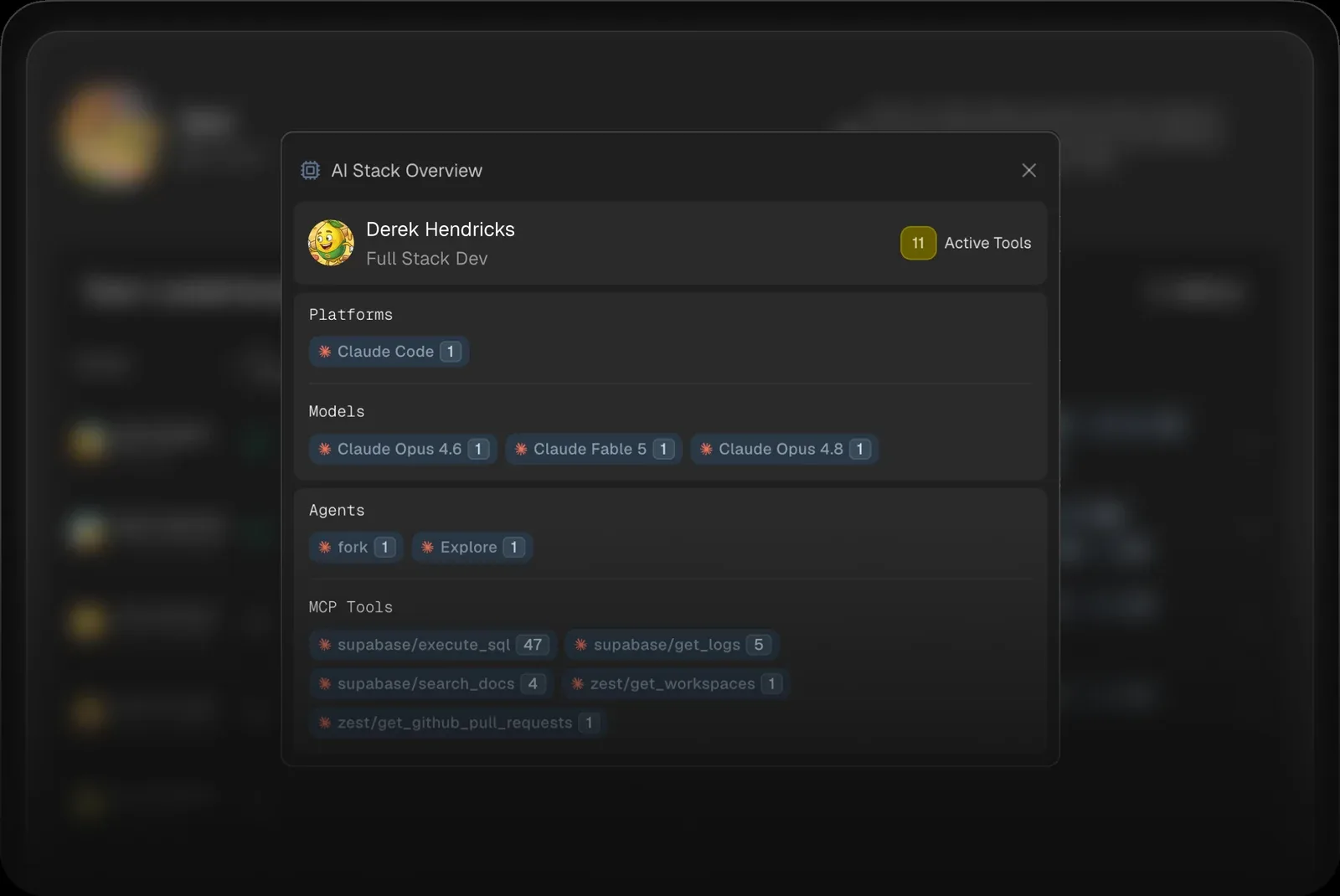
Utilization: which coding agents, models, skills and MCP tools each engineer uses, across Claude Code, Cursor, Codex, GitHub Copilot Chat, Grok Build and Hermes.
Cost: input, output and cache tokens per session, with an estimated cost at model list prices.
Impact: the pull request each session led to, PR throughput (merged pull requests per week, averaged over four weeks) and PR cycle time (median and p75 hours, opened to merged, week over week).
Zest computes no DORA metric and runs no survey: it reads no deployments or incidents, and no Copilot inline completions. Keep your CI/CD, incident and survey tools for those.
Zest's AI Stack overview for one engineer
TRY IT ON YOUR TEAM
See what your team ships with AI.
Starter is free (3 seats, no credit card). Pro is $49 a month with 5 seats and Max is $149 a month with 10 seats — priced per workspace, not per engineer, with extra seats at $19 a month.
What are the most important developer productivity metrics?+
There isn't one. Pick a handful across at least three SPACE dimensions with at least one from a survey, or start from the DX Core 4's four key metrics.
What is PR cycle time?+
The time from a pull request being opened to being merged, reported as a median and a 75th percentile. Some teams start the clock at the first commit instead, which adds coding time.
What is the SPACE framework?+
A framework from GitHub and Microsoft Research (ACM Queue, 2021) with five dimensions: satisfaction and well-being, performance, activity, communication and collaboration, and efficiency and flow. Its authors recommend metrics from at least three of them.
How do you measure AI's impact on software development?+
Measure the work, not the impression of it: which AI tools and models each engineer uses, what each session costs, and whether it ends in a merged pull request. Self-reports mislead: in METR's 2025 trial, developers who took 19% longer believed AI had sped them up by 20%.


 Winding / Team metrics