AI CODING ANALYTICS

AI coding analytics tools
for engineering teams, compared.

Zest joins every coding agent session to the pull request it shipped, the method behind our study of 866 agent-written pull requests. Each agent's own dashboard covers one tool, and Jellyfish, DX, LinearB, Swarmia and Faros AI add AI spend to delivery metrics.

Start free Explore the team demo

Free for 3 seats · No credit card · The demo needs no signup

Zest lemon in its mech suit

01See your team’s AI stack

Winding / Teams Last 30 days

Zest

3 Members 1 Agent
Team overview
67%
AI Adoption▲ 34 pts
240
PRs Merged▲ 101
96.1h
Median AI Time▲ 9.5h
57.2h
Build Hours▲ 20.3h
This week
Member AI PRs/wk AI Task Plan Impl Last Standup AI Stack
22.8/wk28 min ago
15.8/wk12 min ago
4/wkAug 14
—2 hours ago
Current AI models & harnesses As of Sep 8
Claude CodeFable 5.1 (max) (with fallback)70.4 · Coding Agent Index
CodexGPT-6 Astra (max)67.0 · Coding Agent Index
Muse CodeMuse Spark 1.3 (xhigh)64.2 · Coding Agent Index
Grok BuildGrok 4.5 (high)64.1 · Coding Agent Index
Kimi Code CLIKimi K362.6 · Coding Agent Index
OpencodeGemini 3.8 Flash (high)61.2 · Coding Agent Index
Cursor CLIComposer 2.5 Fast38.3 · Coding Agent Index

Demo setups use current model families. The pairings above are the combinations benchmarked by Artificial Analysis; rankings measure performance, not popularity.

Intelligence Index

Illustrative daily trends · Other totals: last 30 days. Build Hours: this week, model-estimated activity including overlap; not engineer hours.

USED BY ENGINEERING TEAMS AT

Flyps Charm Wildfires Geoforge MisaLabs

What is the best AI coding analytics tool for an engineering team?

The best tool is the one that reads the agents your engineers run and answers your question. If you only want to know how one agent is used, its own dashboard comes with the plan. Weighing AI spend against delivery across several agents takes a platform, and seeing which sessions became merged pull requests takes a tool that reads them.

The charts look alike. What differs is where the data comes from. Each vendor's dashboard reads only its own product, while the platforms call those vendors' admin APIs and join the result to Git, issue and CI data. Two tools read the agent itself: DX runs a daemon on each laptop that marks AI-written lines, and Zest adds a plugin that reports each session.

Twelve tools on method, coverage and price

The table lists the three built-in dashboards first, then the platforms in roughly the order buyers' lists name them, with Zest last. We left Span and Waydev out because neither publishes a paid price. Span says it is priced per code contributor and asks you to request pricing, and Waydev quotes its paid plans beside a free Start Up plan for 10 repositories. Both are on the engineering intelligence page.

Prices read on each vendor's own pricing page, AWS Marketplace listing or comparison page on November 10, 2026, and the three built-in dashboards from their own docs the same day. How each platform reads AI work is from its pages and docs read October 5, 2026 (Larridin November 9, 2026; Faros AI and Exceeds AI November 10, 2026).
ToolHow it reads AI codingWhat it showsPublished price
Claude Code analytics (Anthropic)Anthropic's own record of Claude Code in your organizationLines accepted, accept rate and top commands; each member's lines accepted this monthIncluded on Team, Enterprise and the Console
Cursor team analyticsCursor's own record, Cursor onlyAI share of committed code, agent edits, Tab completions and a usage leaderboard, per member for adminsIncluded on Team and Enterprise
GitHub Copilot usage metricsGitHub's own record of Copilot, agents includedAdoption, code generated by users and agents, and pull request output; user-level detail in the APIPart of Copilot, with no separate price
JellyfishEach AI tool's vendor API, plus pull request analysis for AI's footprint in the codeAI impact, delivery, investment allocation and surveys, sold as modulesBy quote; one AWS Marketplace bundle is $30,800 a year for 15 seats
DXAdmin APIs and OpenTelemetry, plus a daemon on each laptop that marks AI-written linesDeveloper surveys, delivery metrics and AI use, impact and costBy quote; its AWS Marketplace listing starts at $15,000 a year, plus $672 per added active contributor
LinearBCursor's and GitHub's APIs, Anthropic's APIs or OpenTelemetry, and Git signals such as co-author trailersDelivery metrics, pull request automation, AI adoption and impact$29 a user a month billed annually for teams of 50 or more; $59 for 100 or more
SwarmiaUsage and cost per person from each vendor's API; AI-assisted pull requests from trailers and labelsDelivery metrics, AI adoption, cost and impact, surveys and capitalizationFree up to 9 developers; AI adoption and cost $5 a developer a month, Standard $45, billed annually
Faros AIOver 100 connectors to coding agents, Git, CI and HR systems, joined by session, commit and pull requestToken spend, adoption and outcomes across teamsConsumption-based, by quote; Faros Desktop is free for individual builders
Exceeds AIConnects to GitHub, GitLab or Azure DevOps and analyzes the code without storing itAI adoption, code quality and ROI per engineer and teamPriced per manager on Pro, billed annually, up to 50 seats; a 7-day free pilot
LarridinGit metadata, coding agent session data and usage from the AI tools' APIsAI spend and adoption in every department; merged work, agent session scores and quality in engineeringFrom $25,000 a year on an annual contract
WeaveEach tool's API where it has one, Git co-authorship where it doesn't, and labeled estimatesA score for every pull request, AI usage, cost and ROIStarter $0 with org-level numbers only; Pro $50 an engineer a month, about 17% less billed yearly
ZestA plugin inside each coding agent, joined to GitHub pull requestsEach engineer's sessions with model, tokens, skills and MCP tools, next to the pull request each led toFree for 3 seats; 5 engineers pay $49 a month on Pro, 10 pay $144 on Pro

Which tool fits your team?

Start from the question you need answered, then check the price at your team size in the table above.

  • If your team runs one agent and you mostly want adoption numbers, use that agent's own dashboard. Claude Code, Cursor and Copilot each show usage per member at no extra cost, though none of them sees the other two.
  • If you run several agents and have a budget to defend, a platform that pulls every vendor's admin API into one view will serve you better. Swarmia's $5 AI adoption and cost plan is the cheapest published paid entry point. Jellyfish, DX, Faros AI and Larridin sell by quote to larger organizations.
  • If AI is one input to a wider delivery review, look at Jellyfish, DX, LinearB or Swarmia. They put AI use next to DORA metrics, surveys and investment reports.
  • If you want to know which sessions turned into merged work, you need a tool that reads the agent. DX marks AI-written lines from each laptop, Faros AI joins sessions to commits and pull requests, and Larridin scores coding agent sessions. Zest shows each session's model, tokens and skills next to the pull request it led to.

What 866 agent-written pull requests show about measuring agents

We measure our own team the way Zest measures yours. From August 12 to October 4, 2026, 866 of the 1,570 pull requests merged in our two main repositories carried a block the coding agent wrote itself: harness, model, and the minutes spent planning, coding and testing. Claude Code wrote 95% of them, the median one merged 37 minutes after it was opened, and coding took only 43% of the agents' session time. The full study has the tables and the method.

Two results matter when you choose a tool. When our AI reviewer read those pull requests, their size predicted its findings far better than the model that wrote them. Most of the gap between models also disappeared once we compared the same engineer, repository and week. A dashboard that ranked models or engineers by tokens alone would have told us the wrong story, and we've written up why token counts mislead on their own.

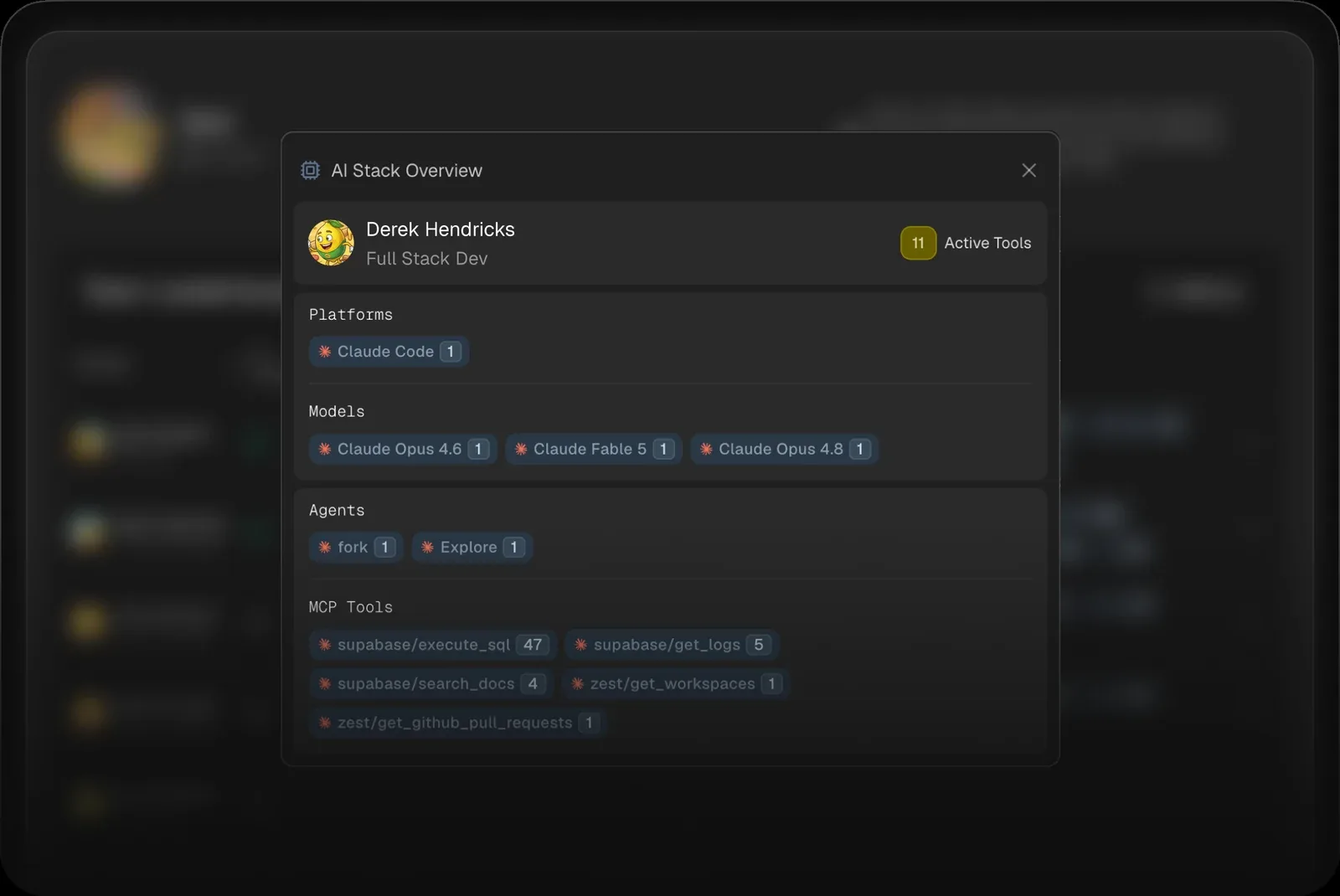
Zest's AI Stack overview for one engineer: platforms, models, agents and MCP tools with usage counts
Zest's AI Stack overview for one engineer

Where Zest fits, and what it doesn't do

Zest is the narrowest tool in the table. Each engineer adds a plugin to Claude Code, Cursor, Codex, GitHub Copilot Chat, Grok Build or Hermes, an admin installs the GitHub App, and every session lands on the team dashboard next to the pull request it led to. Each engineer gets a daily standup in Slack or by email, written from that work. Starter is free for 3 seats with no credit card.

Zest doesn't report delivery or DORA metrics, run developer surveys or handle capitalization, and it reads no issue tracker and no Git host but GitHub. Its cost figures are list-price estimates per session, not your bill, and it doesn't score or rank engineers. If you need any of that, pick a platform from the table. Zest can run beside it.

TRY IT ON YOUR TEAM

See what your team ships with AI.

Starter is free (3 seats, no credit card). Pro is $49 a month with 5 seats and Max is $149 a month with 10 seats — priced per workspace, not per engineer, with extra seats at $19 a month. See pricing

A FEW THINGS TO KNOW

Questions

Is there a free AI coding analytics tool?+

Yes. Claude Code analytics, Cursor team analytics and GitHub Copilot's usage metrics come with their paid team plans, Swarmia is free up to 9 developers, Weave's Starter is $0 with org-level numbers only, and Zest's Starter is free for 3 seats (checked November 10, 2026).

Which tools read Claude Code, Cursor and Copilot together?+

Jellyfish, DX, LinearB, Faros AI and Weave name all three on their own pages, read through the vendors' APIs, OpenTelemetry or Git signals. Zest reads Claude Code, Cursor and Copilot Chat from a plugin inside each one. Each tool's own dashboard reads only itself.

Can a tool show which agent sessions ended in merged pull requests?+

Some can. Faros AI joins session data to commits and pull requests, and Zest shows each session's model, tokens and skills next to the pull request it led to. Tools that read only the vendors' admin APIs see usage and spend, not which session produced which change.