Larridin alternatives: 8 tools, from company-wide AI ROI to one team's agents.
Sources last reviewed
The closest Larridin alternatives are Span and Weave for AI-native engineering analytics, Swarmia for published prices, DX for surveys, Jellyfish for finance reports and Zest for a small team's agent sessions. Larridin's annual enterprise contracts start at $25,000 a year.[1]
Larridin measures AI spend and return in every department, with a browser extension and a desktop application;[2][3] its engineering product and Zest both read the coding-agent session and link it to a pull request. Larridin scores each session out of 100 and each merged change for Engineering Output;[4][5] Zest scores nothing: it shows each engineer's sessions, models and skills next to what merged, and writes a daily standup from them.
Zest gets you:
Zest Pro: $49 a month for 5 engineers, seats included. Larridin, from $2,083/mo for 5 engineers: annual enterprise contracts start at $25,000 a year, priced on usage and seats (read November 9, 2026).[1]
Sign up and connect GitHub today: no contact form, no annual contract
Sample workspace, no signup · Or start free: 3 seats, no credit card
Winding /Teams Last 30 days
Zest
3 Members 1 Agent
Team overview
67%
AI Adoption▲ 34 pts
240
PRs Merged▲ 101
96.1h
Median AI Time▲ 9.5h
57.2h
Build Hours▲ 20.3h
This week
Member
AI
PRs/wk
AI Task
Plan
Impl
Last Standup
AI Stack
22.8/wk
28 min ago
15.8/wk
12 min ago
4/wk
Aug 14
—
2 hours ago
Current AI models & harnesses As of Sep 8
Claude CodeFable 5.1 (max) (with fallback)70.4 · Coding Agent Index
CodexGPT-6 Astra (max)67.0 · Coding Agent Index
Muse CodeMuse Spark 1.3 (xhigh)64.2 · Coding Agent Index
Grok BuildGrok 4.5 (high)64.1 · Coding Agent Index
Kimi Code CLIKimi K362.6 · Coding Agent Index
OpencodeGemini 3.8 Flash (high)61.2 · Coding Agent Index
Cursor CLIComposer 2.5 Fast38.3 · Coding Agent Index
Demo setups use current model families. The pairings above are the combinations benchmarked by Artificial Analysis; rankings measure performance, not popularity.
Illustrative daily trends · Other totals: last 30 days. Build Hours: this week, model-estimated activity including overlap; not engineer hours.
USED BY ENGINEERING TEAMS AT
AT A GLANCE
Larridin and Zest, from scope to the first invoice
Larridin and Zest, from scope to the first invoice
Zest
Larridin
What it measures
Each engineer's coding-agent sessions and the pull requests they led to, with a daily standup written from them.
AI spend, adoption and fluency in every department; for engineering, Engineering Output (merged work weighted by complexity), coding-agent session scores, quality and delivery.[2][5]
Coding agents it reads
Claude Code, Cursor, Codex, GitHub Copilot Chat, Grok Build and Hermes.
Sessions from Claude Code, Codex, Cursor and OpenCode; GitHub Copilot, Devin, Gemini CLI and Antigravity are in its catalog, which “does not imply identical session coverage”.[4]
Scores each pull request
No: Zest doesn't score or rank pull requests or engineers.
Yes: Engineering Output scores each merged change on complexity, size, missing tests and AI slop; Agent Effectiveness scores each session out of 100 on six dimensions, with citations.[4][5]
Per-engineer view
Yes: Each engineer's sessions, models, skills and MCP tools, next to their pull requests.
Partly: “Team level by default; individual views are coaching context for the engineer.”[6]
How it reads AI coding
A plugin or extension in each engineer's agent uploads every session: prompts, replies, model, tokens, tools, skills and MCP calls. Cursor's token counts come from Cursor's dashboard, only if the engineer turns that on.
Git metadata, coding agent session data and usage from the AI tool APIs. Session cost is estimated from model list prices; billed spend shows “where a billing connection is available”.[4][7]
Self-hosting and on-prem Git
No: Zest is cloud-hosted and connects GitHub only.
Partly: On-prem in your data center or bring your own cloud; its pages name no on-prem Git host.[8]
Git hosts
GitHub only, through the Zest GitHub App.
Its engineering pages name GitHub and GitLab.[5][9]
Free plan or trial
Yes: Starter is free for 3 seats, no credit card.
No: No free plan or trial listed: Try Now, Get Pricing and Book a Demo all open a contact form, answered “within one business day with pricing and a calendar link”.[8]
Cost for 5 engineers
$49/mo for 5 engineers: one Pro workspace, seats included.
From $2,083/mo for 5 engineers: annual enterprise contracts start at $25,000 a year, priced on usage and seats.[1]
Cost for 20 engineers
$334/mo for 20 engineers: one Pro workspace, 5 seats included and 15 added at $19 each.
From $2,083/mo for 20 engineers: annual enterprise contracts start at $25,000 a year, priced on usage and seats.[1]
Facts from each vendor's own pages and AWS Marketplace listings, dated in the sources below. ✓ listed, – partly, × not listed on the pages we read, which is not proof the product lacks it.
Not starting today? What's in the way?
When Larridin is the better pick
Larridin does several things Zest doesn't, and for these buyers it is the right tool:
You have to report AI's return outside engineering. Larridin measures adoption, fluency and spend in sales, support, finance and every other department; Zest only sees coding agents.
Your code is on GitLab, or security wants on-prem or your own cloud. Larridin names GitHub and GitLab and offers all three deployments; Zest is cloud-only and GitHub-only.
You want delivery data beside the sessions: DORA views, CI, deploys and incidents. Zest has pull request throughput and cycle time from GitHub, and no DORA metrics.
You want work scored. Larridin weighs each merged change by complexity and scores each agent session; Zest has no score and collects no code diffs to build one from.
You want token spend cut for you. The Larridin Router picks a model for each coding request; Zest reports what each session cost and changes nothing.
What Larridin costs, and where it says so
Larridin has no pricing page. The price is in the FAQ of its own comparison pages: “Annual enterprise contracts start at $25,000 a year, we price it both based on usage and seats.” On its site, Try Now, Get Pricing and Book a Demo all open the same contact form, which promises a reply within one business day with pricing and a calendar link. Its pages list no free plan and no self-serve trial.
That floor works out to about $2,083 a month before the first seat, so Larridin is priced for an enterprise rollout, as its own pages say. A team of 5 that only wants its coding-agent sessions pays Zest $49 a month on Pro, or nothing for 3 seats.
Larridin's published price and buying steps, from its comparison and contact pages, read November 9, 2026
Larridin
Starting price
$25,000 a year
Contract
Annual, enterprise
Priced on
Usage and seats
Pricing page
None; the price is on its comparison pages
Free plan or trial
None listed
How you start
A contact form, answered within one business day
How Larridin reads Claude Code, Codex and Cursor
Larridin's engineering product, Developer Intelligence, reads Git metadata, coding agent session data and usage from the AI tool APIs. Agent Effectiveness lists sessions from Claude Code, Codex, Cursor and OpenCode with their prompts, agent turns, tokens, estimated cost and linked pull requests, and scores each on six dimensions: prompt clarity, session steering, sophistication, prompt quality, verification discipline and task outcomes. GitHub Copilot, Devin, Gemini CLI and Antigravity are in its catalog, with a note that a tool listed there may not have the same session coverage.
Session cost is an estimate from model list prices, cache writes and reads priced apart; billed spend appears where a billing connection exists. Larridin tells buyers to check collector and redaction settings before turning on transcript collection. Zest's plugin sits inside each agent, redacts secrets on the laptop and uploads the session; Claude Code analytics shows what that looks like for one team.
The half of Larridin that isn't about code
Most of Larridin is not about code. Its FAQ describes a browser extension and a desktop application, deployed centrally, that detect which AI tools people use across the company, approved or not. On top of that sit AI Adoption and AI Fluency scores by department, Spend Intelligence for licenses, tokens and cloud model costs, and Workflow Intelligence, which looks for repeated work to automate. The seven tools below are engineering tools, and so is Zest. If the question on your desk is the whole company's AI budget, the alternatives are a different shortlist from this one.
Span and Weave: the AI-native pair Larridin names
Larridin's own compare page calls Span and Weave “AI-native engineering intelligence”, the generation before its own. Span records Claude Code and Cursor sessions with an agent on each laptop and ties them to pull requests, at $45 a contributor a month. Weave has a model score every pull request; its Starter plan is free with org-level numbers, and Pro is $50 an engineer billed monthly, less on yearly billing. Both publish a price a team can check without a call.
Swarmia: the per-developer price list
Swarmia is free for companies with fewer than 10 developers and sells AI adoption and cost on its own at $5 a developer a month, billed annually. It reads Claude Code, Cursor, Copilot and Codex usage from each vendor's API, and its Standard and Enterprise plans are $45 and $55. Every price is on its pricing page, which is the difference a small team will notice first.
DX and Jellyfish: surveys and finance
Larridin says of itself that it is not a developer survey tool. DX, now part of Atlassian, is built around survey programs and benchmarks, and sells after a demo. Jellyfish maps engineering work to investment and sells software capitalization reports, by quote. Pick either when the report is for HR or finance, not for the team running agents.
LinearB and Waydev: rules on pull requests, and more Git hosts
LinearB acts on each pull request with gitStream rules and AI code reviews, from $29 a user a month, billed annually, for at least 50 users. Waydev connects Bitbucket, Azure DevOps and Gerrit as well as GitHub and GitLab, and bills per active contributor, annually.
Zest: one team's agent sessions, without a contract
Zest is ours, and it is much smaller than Larridin. A plugin or extension in each engineer's agent records the session, the Zest GitHub App links it to the pull request it led to, and each engineer gets a standup written from the day's work. Starter is free for 3 seats with no credit card; Pro is $49 a month for a workspace of 5, billed monthly.
Its limits: GitHub only, cloud only, closed-source plugins, no code diffs, no DORA metrics, no surveys, no capitalization, no router, and nothing outside engineering.
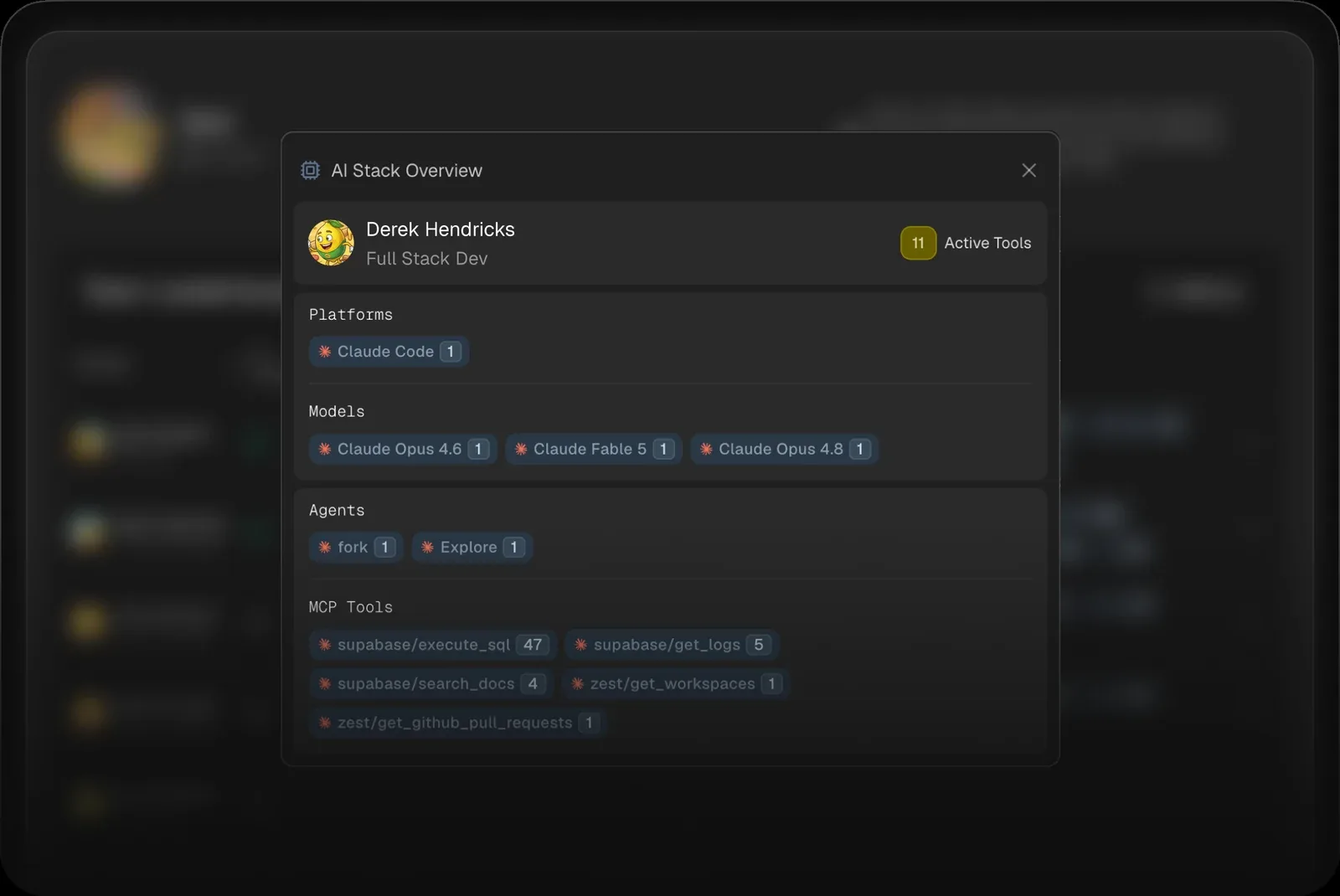
Zest's AI Stack overview for one engineer
How to choose a Larridin alternative
Start from why Larridin doesn't fit:
The $25,000 floor or the annual contract: Swarmia, Weave or Zest have free plans; Span lists $45 a contributor.
You want sessions tied to pull requests, engineering only: Span or Zest.
You want a score per pull request without the company-wide platform: Weave.
You run a survey program: DX.
Finance needs capitalization: Jellyfish.
Bitbucket or Azure DevOps: Waydev.
Nothing above is the problem and you need AI measured across every department: stay with Larridin.
TRY IT ON YOUR TEAM
See what your team ships with AI.
Starter is free (3 seats, no credit card). Pro is $49 a month with 5 seats and Max is $149 a month with 10 seats — priced per workspace, not per engineer, with extra seats at $19 a month. See pricing
Larridin's annual enterprise contracts start at $25,000 a year, priced on usage and seats, according to the FAQ on its own comparison pages (checked November 9, 2026). It has no pricing page and lists no free plan; you ask for a quote through a contact form.
What is the best Larridin alternative?+
For agent sessions tied to pull requests in engineering only, Span or Zest. For a score per pull request with a free tier, Weave. For published per-developer prices, Swarmia. For surveys, DX; for finance reports, Jellyfish. To measure AI across every department, no tool on this list replaces Larridin.
Does Larridin track Claude Code, Codex and Cursor?+
Yes. Its Agent Effectiveness page lists sessions from Claude Code, Codex, Cursor and OpenCode with tokens, estimated cost and linked pull requests, and scores each session; GitHub Copilot, Devin, Gemini CLI and Antigravity are in its catalog with a coverage caveat (checked November 9, 2026).
Is Larridin only for engineering teams?+
No. Developer Intelligence is its engineering product; the rest of the platform measures AI adoption, fluency, spend and workflows in every department, with a browser extension and a desktop application.
Does Larridin run on-prem?+
Its contact page lists three deployments: cloud managed by Larridin, on-prem in your data center, and bring your own cloud (checked November 9, 2026). Zest is cloud-hosted only.

 Winding / Teams






 Zest