
Claude Code Alternatives: 6 Coding Agents Compared (2026)
Related guide: Claude Code vs Codex for teams
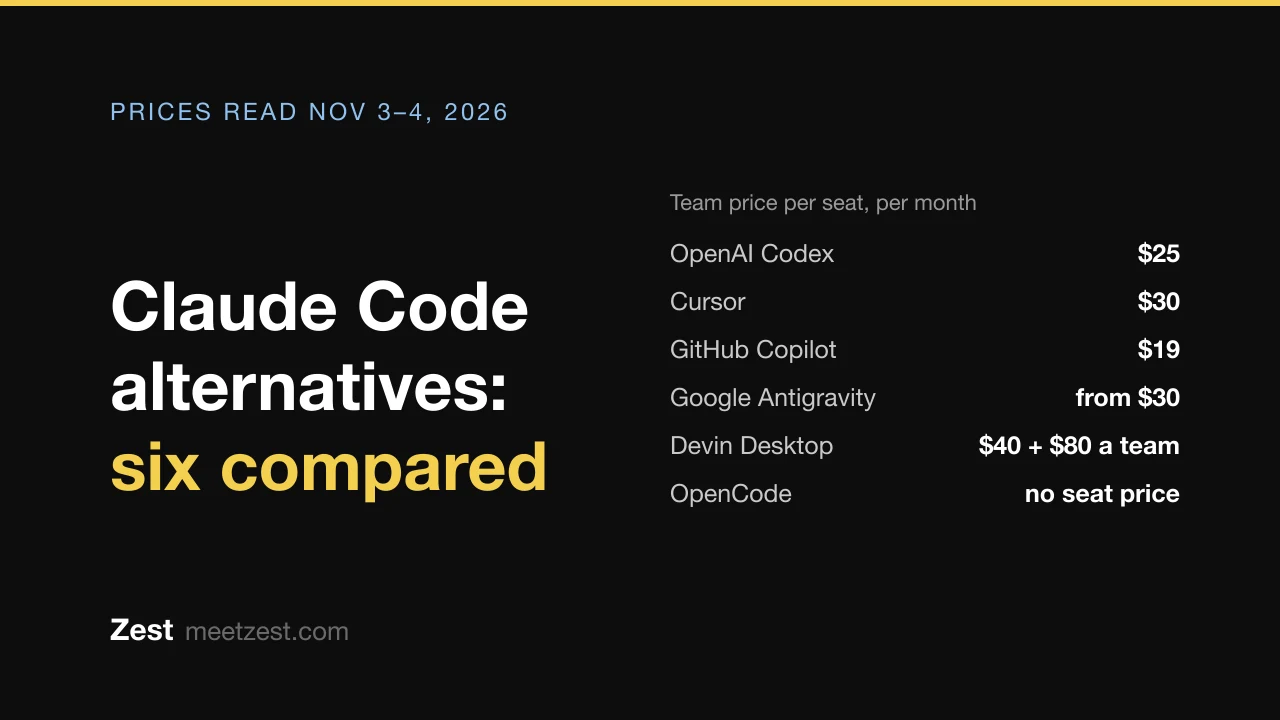
The main Claude Code alternatives are OpenAI Codex, Cursor and GitHub Copilot, followed by Google Antigravity, Devin Desktop and the open-source OpenCode. Which one fits depends on why you’re looking: usage limits point to a different place than wanting other models, an editor or local models. You may not have to choose, either: Claude Code’s and Codex’s extensions both install in Cursor.
Zest shows which coding agents and models each engineer uses, across Claude Code, Codex, Cursor and Copilot Chat, so you can compare them on your own pull requests. Start free
Claude Code is the one to beat on adoption. In JetBrains’ survey of more than 15,000 professional developers, 39% used it at work in May to July 2026, up from 18% in January, against 16% for Codex, 12% for Cursor, 7% for OpenCode and 6% for Antigravity (JetBrains Research). GitHub Copilot sits at about half of Claude Code’s share. We sell analytics for coding agents, not a coding agent. Claude Code is our own default, though, so read this with that in mind.
Claude Code alternatives at a glance
| Tool | What it is | Models | Team price | Free option |
|---|---|---|---|---|
| Claude Code (for reference) | Anthropic’s coding agent | Claude only | $25 a seat a month, $20 billed annually (Team Standard); $125 or $100 (Premium) | None |
| OpenAI Codex | OpenAI’s coding agent | OpenAI GPT models: GPT-6.1 Sol, GPT-6.1 Terra, GPT-6 Astra, GPT-6 Luna | $25 per user a month, $20 billed annually (ChatGPT Business) | GPT-6 Luna on Free and Go, in the desktop app, subject to rollout |
| Cursor | AI code editor with its own agent | Cursor’s Composer and Grok, plus Claude, GPT and Gemini at API list price | $30 per user a month (Teams Premium), and third-party models bill on top | Limited Agent and Chat, no third-party models |
| GitHub Copilot | GitHub’s assistant and agent | Models from OpenAI, Anthropic, Google, xAI and others | $19 a seat with 1,900 AI credits (Business); $39 with 3,900 (Enterprise); one credit is a cent | Limited chat and agent use |
| Google Antigravity | Google’s agentic IDE and CLI | Gemini models, plus some Claude and GPT-OSS models | From $30 a seat through Gemini Enterprise, or $0 a seat with pay-as-you-go | Individual plan, basic weekly limits |
| Devin Desktop | Cognition’s AI editor, formerly Windsurf | Cognition’s SWE-2, plus OpenAI, Claude, Gemini, SpaceXAI and open models | $80 a month for the team plan plus $40 per full dev seat | Light quota |
| OpenCode | Open-source agent (MIT) for terminal, desktop and IDE | 75+ providers, including local models | No seat price; you pay your model provider | Free, with free models that need no account |
Vendor pages read on November 4, 2026 (Cursor on November 3): Claude, Codex, Cursor, Copilot, Antigravity, Devin, OpenCode. Prices in this market move monthly, so check before you buy.
Which alternative fits, by why you’re leaving
You keep hitting usage limits. Our heaviest engineer saw a limit notice on 16 of 29 active days on Claude’s top plan at the time, so this is real. Before switching, check Claude Code’s plans and limits: usage credits, Premium seats or an API key may be cheaper than a migration. If you do want a second pool, Codex is the usual pick. OpenAI estimates 15 to 160 local messages per five hours on GPT-6.1 Sol on Plus and Business, and Codex pricing has the rest.
You want models other than Claude. Claude Code won’t give you that: Anthropic doesn’t support routing it to non-Claude models through any gateway. Cursor, Copilot and OpenCode all offer a choice of vendors, and all three can still run Claude models, so you can move without giving those up.
You want a lower bill. Try this before you switch: Sonnet 5.5 in Claude Code lists at the same $2 and $10 per million as GPT-6.1 Sol, half of Claude Opus 5.5’s $4 and $20. On Artificial Analysis’ Coding Agent Index, read on October 5, Codex with GPT-6.1 Sol at xhigh effort scored 62.9 at $1.04 a task, and Claude Code with Opus 5.5 at max effort scored 66.0 at $13.04. Claude Code with Sonnet 5.5 scored 68.4 at max effort and 62.9 at xhigh, for $3.33 a task. Effort moves these numbers a lot, as we show in best model for coding. Among flat team seats, Copilot Business is the lowest here, with 1,900 AI credits included. Check what happens past those credits before you count on the seat price.
You want an editor rather than a terminal. Claude Code has VS Code and JetBrains extensions, so this may not need a switch. If you want the editor to be the product, look at Cursor or Devin Desktop, or Antigravity if you’re on Google. We compare the closest pair in Claude Code vs Cursor.
You need open source or local models. OpenCode is the option here. It’s MIT-licensed, works with 75+ providers including local models, and says it doesn’t store your code or context, except when you use its free models. Your costs and quality then depend on the model you choose.
You already pay for something else. ChatGPT Business includes Codex, so a company on it already has an agent ready to try. The same goes if your company already buys Copilot seats or Gemini Enterprise. See Claude Code vs GitHub Copilot and Claude Code vs Codex.
What moves with you if you switch
This is the part most comparisons skip, and it’s what makes a switch cheap or expensive for a team.
| What you built for Claude Code | Codex | Cursor | GitHub Copilot |
|---|---|---|---|
CLAUDE.md, .claude/rules/ |
AGENTS.md, so rename or import |
Applies CLAUDE.md as is, plus .cursor/rules and AGENTS.md |
AGENTS.md and CLAUDE.md in the cloud agent and CLI; .github/copilot-instructions.md |
Skills in .claude/skills |
.agents/skills, same Agent Skills standard |
Loads .claude and .codex skills |
Reads .github, .claude or .agents skills |
Subagents in .claude/agents |
Its own custom agents | Loads .claude agents; also .cursor/agents |
Its own custom agents |
| Hooks | Has hooks, its own config | Has hooks, its own config | Has hooks, its own config |
| MCP servers | Move to config.toml |
Move to mcp.json |
Supported; for Business and Enterprise the policy is off by default |
| Your plan and limits | Separate plan | Separate plan and prepaid credit | Separate plan and AI credits |
From each vendor’s docs, as cited on our comparison pages (read October 5, 2026). Instructions and skills mostly carry over. Hooks and CI scripts are what you rewrite. Keeping your rules in AGENTS.md and importing it from CLAUDE.md is a cheap hedge either way, since CLAUDE.md can import other files.
How to test an alternative fairly
We compared Codex and Claude Code on our own repositories. Our raw numbers said Claude Code’s PRs were flagged 27% of the time and Codex’s 21%. Matched on the same repository, engineer and week, the difference was +1 point, with a 95% interval of −16 to +20, on 24 Codex PRs against 162 Claude Code PRs. Both had a median of 37 minutes from opened to merged. At that sample size it’s a coin flip. So be wary of anyone’s ranking, ours included.
A fair test on your team:
- Run both in the same weeks, with the same engineers. Otherwise you are comparing the calendar.
- Pick your measures first. Cost per merged PR, time to merge, review findings, fix rounds.
- Keep PR size comparable. On our data, size moved review findings far more than the tool. See Claude Code best practices for teams.
- Check who’s still using it after two weeks. Survey shares say what’s popular. Retention on your team says what’s useful.
Zest records sessions across Claude Code, Codex, Cursor and Copilot Chat and joins them to the pull requests they led to, so this comparison doesn’t take a spreadsheet. Its Starter plan is free for three seats.
Frequently asked questions
What is the best alternative to Claude Code?
For most teams, OpenAI Codex or Cursor. Codex suits teams already on ChatGPT and offers a lower price per token. Cursor suits teams that want an editor and a choice of models. On our own repositories, Codex and Claude Code came out about even once we compared the same engineers in the same weeks.
Is there a free alternative to Claude Code?
Yes. OpenCode is free and open source, with free models that need no account, though other providers cost what they charge. Google Antigravity has a free individual plan with basic weekly limits. Cursor, GitHub Copilot and Devin have limited free plans, and Codex offers GPT-6 Luna on Free and Go, subject to rollout.
Can Claude Code use other models?
Anthropic doesn’t support routing Claude Code to non-Claude models, through any gateway. If you need other vendors’ models, use Cursor, GitHub Copilot or OpenCode, which also run Claude models.
Is Codex better than Claude Code?
It depends on your work, and small comparisons are noisy. On Artificial Analysis’ index, read on October 5, 2026, they were within a few points at high effort settings, with Codex far cheaper per task. On our repositories the matched difference in review findings was +1 point, with an interval of −16 to +20. See Claude Code vs Codex.
Is there a cheaper alternative to Claude Code?
Often, yes, though Claude Code’s own Sonnet 5.5 lists at the same token price as GPT-6.1 Sol, half of Opus 5.5’s, so try that first. A GitHub Copilot Business seat is $19 with 1,900 AI credits. With OpenCode you pay only your model provider. What matters is cost per merged pull request, which you can only measure on your own team.
Can a team use Claude Code and an alternative together?
Yes. Claude Code’s and Codex’s extensions both install in Cursor, each billing to its own vendor’s plan, and instructions in AGENTS.md work across tools. The hard part is seeing usage across them, since each vendor’s dashboard covers only its own tool.