Software engineering intelligence (SEI) platforms join Git, issue-tracker and CI data to report delivery, and most now report AI adoption and spend.[1][2][3] Weave, LinearB, Swarmia, Span and Waydev publish per-engineer prices;[4][5][6][7][8] DX and Jellyfish sell by quote.[9][10]
Zest is narrower: a plugin in each engineer's coding agent reports every session (model, tokens, skills, MCP tools), and Zest joins it to merged GitHub pull requests. It has no DORA metrics, surveys or capitalization; 5 engineers pay $49 a month on Pro.
Zest gets you:
Zest Pro: $49 a month for 5 engineers, seats included
Each column links to that vendor's own comparison; hover a cell for the sentence behind it. Facts from each vendor's own pages and AWS Marketplace listings, dated in the sources below. ✓ listed, – partly, × not listed on the pages we read, which is not proof the product lacks it.
WHAT IT COSTS
5 engineers, priced per workspace.
Zest charges one workspace price with seats included. Most of the category charges per engineer, or by quote. Switch the team size to see where each lands.
MONTHLY COST, LIST PRICEWhat your team pays a month
Zest is one price per workspace with seats included. The others are charted at their cheapest published plan that shows AI use per engineer (Weave Pro at $42 an engineer; LinearB Essentials at $29 a user, at least 50 users; Swarmia AI adoption & cost at $5 a developer, free under 10; Span at $45 a contributor; Waydev Pro at $29 an active contributor), or from their smallest AWS Marketplace contract (DX and Jellyfish). Sources.
What is a software engineering intelligence (SEI) platform?
An SEI platform connects to your Git host, issue tracker and CI, and computes delivery metrics from them: cycle time, throughput, DORA and where engineering time goes. Most now add AI adoption, spend and impact; some add developer surveys and R&D capitalization. Choosing which of these to report as engineering KPIs comes before choosing a platform. The DORA metrics guide explains the four delivery measures.
Four ways the platforms measure AI coding
The grid above says which method each platform uses. They see different things:
How each platform reads AI coding, from its own pages and docs, read October 5, 2026 (Weave's November 15, 2026)
Method
Who uses it
What it sees
What it misses
Admin APIs and OpenTelemetry from each AI tool
Jellyfish, LinearB, Swarmia, DX, Waydev, Weave; Span for spend
Active users, tokens and spend per person and tool
What the agent did, and which pull request it led to
Git and code signals
LinearB, Swarmia, Weave, Waydev, Jellyfish, Span
Co-author trailers, labels, branch names, or a model reading the diff
AI work that leaves no trailer, and its cost
Hooks or a daemon on each laptop
DX (lines), Span (whole sessions), Weave (plugins in Claude Code, Codex and Cursor)
Which lines an agent wrote; for Span and Weave, the prompts and tool calls too
An install on every machine, often by MDM
A plugin inside each agent
Zest
Each session's model, tokens, skills and MCP tools, joined to its pull request
A plugin per engineer; no delivery data beyond pull requests
Which platforms show cost per merged pull request and defect rate?
None of the vendor pages we read shows both in one AI view, at any team size. Waydev's Premium plan compares AI tools on cost per commit, per pull request and per feature, and Swarmia's ROI tab shows what each merged pull request costs, split into developer and AI. Weave's PR AI cost estimates the AI cost behind each pull request in API-equivalent dollars, once it is turned on for the organization and its coding-agent plugins report enough telemetry; that is an estimate per pull request, separate from billed spend, not an average cost per merged pull request. Defect signals sit apart: Span tracks a rising defect rate and Weave tracks revert rates. A 300-engineer org should ask each vendor it shortlists to show both numbers on a sample of its own repositories.
Mapping AI spend to output across GitHub and CI/CD takes both sides: spend from each AI tool's admin API or OpenTelemetry, and delivery data from Git and CI. Jellyfish and DX connect Git, CI and incident tools beside the AI tools' APIs. Zest covers the GitHub half: each session's tokens and estimated cost next to the pull request it led to, with no CI, issue tracker or incident data.
From the vendor pages that name either measure, read November 8, 2026 (Weave's November 15, 2026). "Not listed" means the page names no such measure.
Platform
Cost per merged pull request
Defect or quality signal
Waydev
Cost per commit, per pull request and per feature (Premium)
Not listed
Swarmia
What each merged pull request costs, developer and AI
Not listed
Span
Not listed
A rising defect rate
Weave
An estimated API-equivalent AI cost for each pull request, where enabled and its coding-agent plugins are installed; separate from billed spend
Revert rates, and bugs traced to the pull request
Jellyfish
Not listed
Code quality and cost efficiency, tied to AI spend
Zest
Each session's tokens and estimated cost, next to the pull request it led to
None: no CI, issue tracker or incident data
How much do engineering intelligence platforms cost per developer?
Where a per-developer price is published, it runs from $5 to $49 a month, billed annually or on a one-year contract: Swarmia from $5, LinearB Essentials and Waydev Pro at $29, Weave Pro at $42, Span at $45 and Waydev Premium at $49. Jellyfish and DX have no per-developer list price and sell by quote. Zest prices per workspace, not per developer; the grid and chart above show what a small team pays on each.
Which SEI platform is best for your team size?
From each vendor's pricing page or AWS Marketplace listing:
Fewer than 10 engineers: Swarmia's free plan, Waydev's free Start Up plan (10 repositories), Weave's free Starter (org-level numbers only) or Zest's free Starter (3 seats).
10 to 50 engineers: Swarmia from $5 a developer a month, Waydev Pro at $29, Weave Pro at $42, Span at $45 on a one-year contract, or Zest at $144 a month for 10 on Pro.
50 or more: LinearB bills at least 50 users on Essentials and 100 on Enterprise. Jellyfish's one public bundle is $30,800 a year for 15 seats, and DX's listing starts at $15,000 a year.
Where Zest fits
Zest is AI coding analytics, narrower than the platforms above. It starts from the coding agents your engineers run, then joins them to what merged on GitHub.
What it writes: each engineer's standup at 6pm local time, in Slack or by email, and a weekly digest for the workspace owner.
What it lacks: DORA, surveys, capitalization, PR automation, issue trackers and any Git host but GitHub. It ranks no one.
What it costs: Starter is free for 3 seats with no credit card; 10 engineers pay $144 a month on Pro, billed monthly.
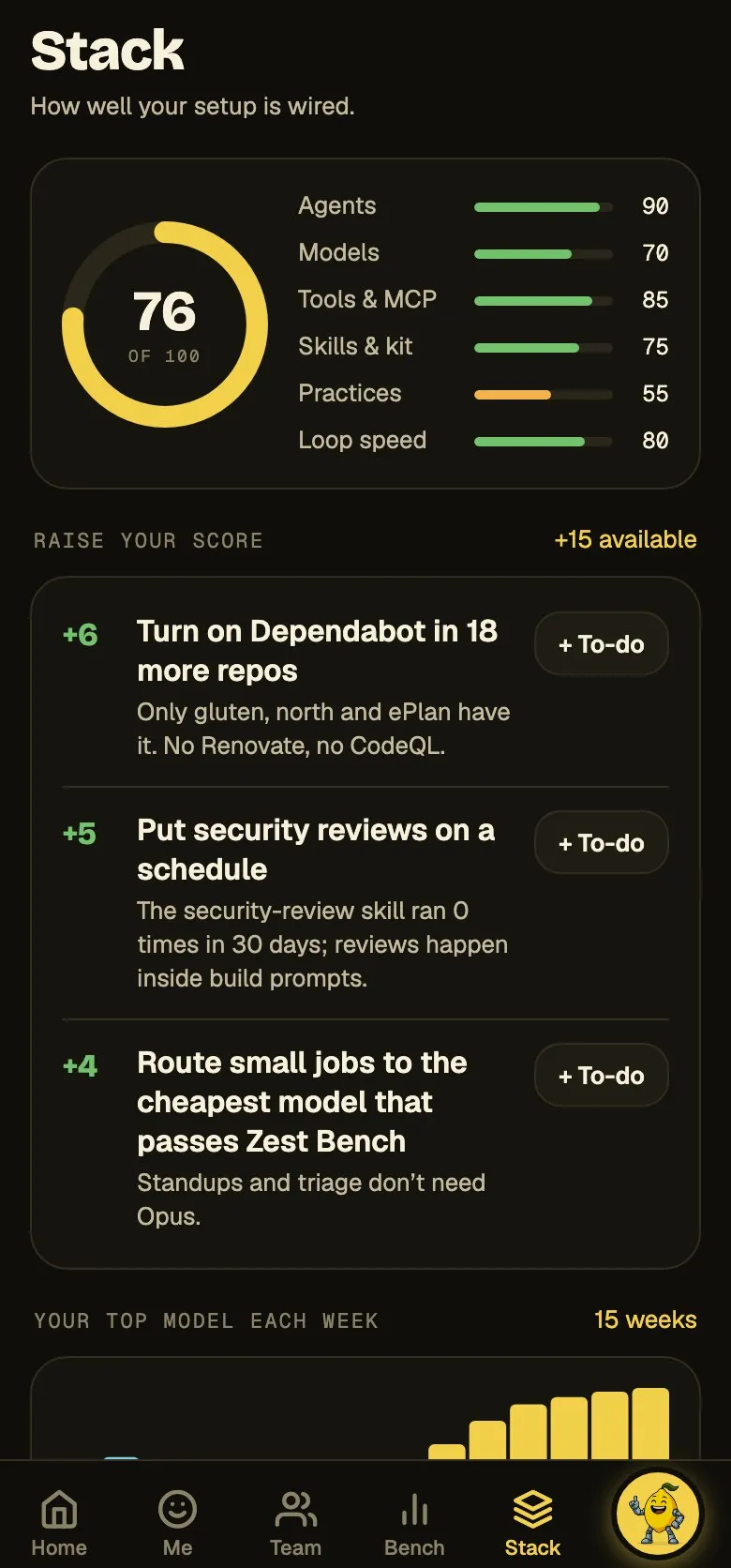
Stack in the Zest app: how well your setup is wired, and what raises the scoreSample data
Questions to ask any vendor in a trial
Put the same questions to each platform you are weighing:
Which AI tools does it read, and through what: an admin API, OpenTelemetry, Git trailers or an agent on each laptop?
Is AI cost per engineer, and is it list price or what you pay?
Does it read or store source code, prompts or diffs, and in which region?
What must be installed on each laptop, and who approves that?
TRY IT ON YOUR TEAM
See what your team ships with AI.
Starter is free (3 seats, no credit card). Pro is $49 a month with 5 seats and Max is $149 a month with 10 seats — priced per workspace, not per engineer, with extra seats at $19 a month. See pricing
Which engineering intelligence platforms publish their prices?+
Weave, LinearB, Swarmia, Span and Waydev publish per-engineer prices, Span on its comparison pages only. DX and Jellyfish sell by quote with a contract listed on AWS Marketplace, and Zest publishes per-workspace prices (checked October 5, 2026).
Which one is free for a small team?+
Swarmia is free for companies with fewer than 10 developers, Waydev's Start Up plan and Weave's Starter cost $0 with fewer features, LinearB offers a 45-day trial, and Zest's Starter is free for 3 seats with no credit card (checked October 5, 2026).
Which platforms read Claude Code and Cursor usage?+
Jellyfish, LinearB, Swarmia, DX, Waydev and Weave read both through the vendors' admin APIs or OpenTelemetry. Span, Weave and Zest also read each session from inside the agent: Span with an agent on each laptop, Weave and Zest with a plugin.
How long does Zest take to set up?+
Minutes: an admin installs the Zest GitHub App and picks repositories, and each engineer adds the Zest plugin or extension to their coding agent. The backfill of past pull requests can take a few minutes for larger orgs.






 Zest