Span alternatives: 7 tools, from agent traces to finance reports.
Sources checked
The closest Span alternatives are Jellyfish for finance reports, DX for surveys, Swarmia, Waydev or Weave for lower published prices, and Zest for agent sessions through a plugin per engineer. Span's laptop agent records Claude Code and Cursor sessions, at $45 a contributor a month.[1][2]
A Span trace holds “prompts sent, MCP calls made, files edited, skills used, and the tokens spent”, and only its author sees the prompts.[1] Span adds allocation, capitalization, R&D tax credits and surveys on contracts from one year;[3] Zest adds a daily standup per engineer.
Zest gets you:
Zest Pro: $49 a month for 5 engineers, seats included. Span, $225/mo for 5 engineers: Span at $45 a contributor a month, with contracts from one year (read October 5, 2026).[2]
Free for 3 seats · No credit card · or run npx @winding-labs/zest
Sample data
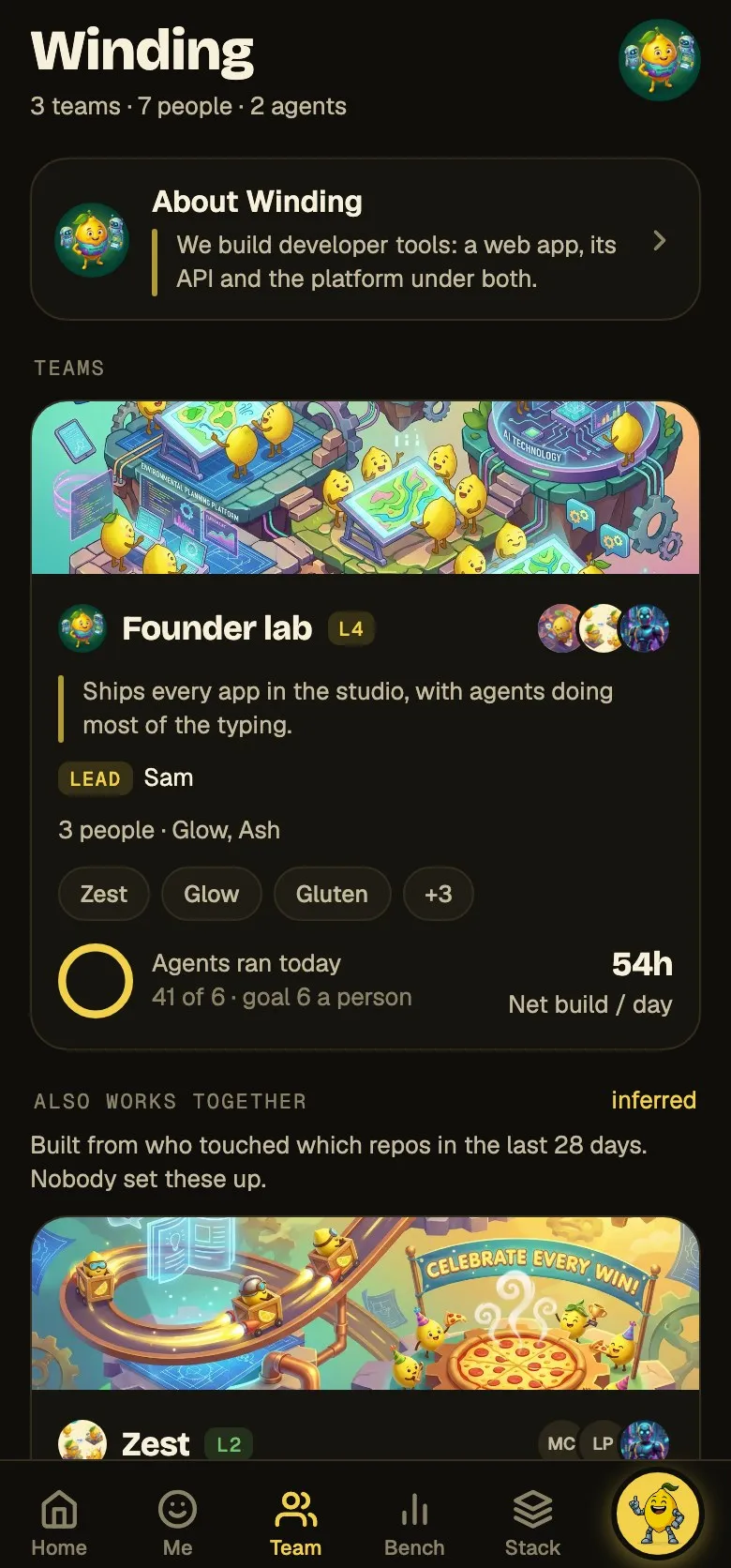
Team in the Zest app: your teams, who's on them and the agent work they ran
USED BY ENGINEERING TEAMS AT
AT A GLANCE
Span's traces and Zest's sessions, row by row
Span's traces and Zest's sessions, row by row
Zest
Span
What one agent session records
In Claude Code: prompts, replies, model, token counts, tools and skills, linked to the pull request by commit SHA or PR URL, with secrets redacted on the laptop.
“Prompts sent, MCP calls made, files edited, skills used, and the tokens spent”, linked to the PR it produced and scored by agent evals; prompts are visible to their author only.[1]
Coding agents it reads
Claude Code, Cursor, Codex, GitHub Copilot Chat, Grok Build and Hermes.
Claude Code and Cursor, their cloud agents included; its earlier hooks guide also lists Codex CLI, Copilot CLI and VS Code chat.[1][4]
Setup
An admin installs the Zest GitHub App; each engineer adds the plugin or extension to their agent. No MDM and no demo.
IT installs Span's agent on each laptop through MDM (Jamf, Intune, Kandji and others), or engineers self-install; Linux is in beta.[1]
Hosting and code access
Cloud only. The plugins upload session transcripts, never code diffs, after redacting secrets on the laptop; the GitHub App never writes to your code.
SaaS on AWS in the US. The laptop agent sends prompt text, tool calls and file diffs; retention is 90 days by default, and each developer can turn on privacy mode.[5]
Software capitalization
No: Zest has no capitalization or allocation reports.
Yes: Engineering allocation, software capitalization and R&D tax credits.[3]
Cost for 5 engineers
$49/mo for 5 engineers: one Pro workspace, seats included.
$225/mo for 5 engineers: Span at $45 a contributor a month, with contracts from one year.[2]
Cost for 20 engineers
$334/mo for 20 engineers: one Pro workspace, 5 seats included and 15 added at $19 each.
$900/mo for 20 engineers: Span at $45 a contributor a month, with contracts from one year.[2]
Facts from each vendor's own pages and AWS Marketplace listings, dated in the sources below. ✓ listed, – partly, × not listed on the pages we read, which is not proof the product lacks it.
Both start from the agent session
Most software engineering intelligence platforms read AI use from vendor APIs or Git; Span and Zest read the agent's own record of each session (Weave's plugins now do too). Span runs evals over each trace and traces each line of a pull request back to the agent that wrote it. Zest records each session's model, tokens, estimated cost, skills and MCP tools, links it to its pull request by commit SHA or PR URL, and writes the day's standup from it.
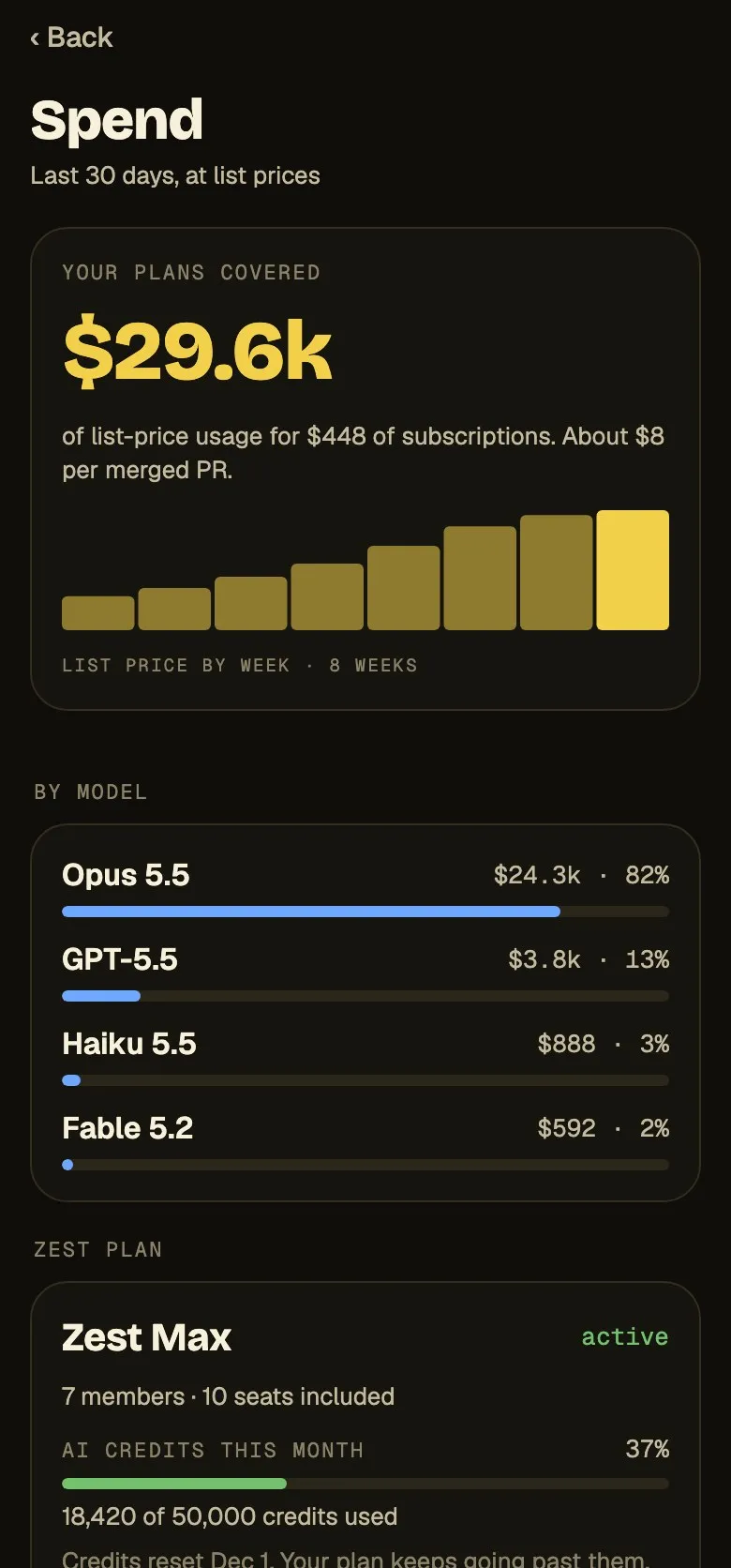
Spend in the Zest app: your agent usage at list prices, by week and by modelSample data
MDM rollout or a plugin per engineer
Span's agent installs through MDM on macOS (Jamf, Intune, Kandji, Mosyle and others) and Windows (Intune, Rippling, Hexnode), or by self-install; Linux is a beta self-install. Span's team switches traces on for your organization and suggests a pilot for larger ones. Zest needs an admin to install the GitHub App; each engineer then adds the plugin.
What leaves the laptop
Span's agent sends prompt text, tool inputs and outputs, and file diffs to Span's backend on AWS in the US. Retention is 90 days by default, down to 30, and each developer can turn on privacy mode.
Zest's plugins send the session transcript, prompts and replies included, after redacting secrets with more than 40 patterns on the laptop; if redaction can't start, nothing is captured. The Claude Code setup guide lists what the plugin records and never sends.
Jellyfish: the finance reports, from vendor APIs
Jellyfish keeps Span's finance side: capitalization next to delivery from Git, Jira or Linear, CI and incident tools, with DevFinOps sold as its own module. It reads AI use from each tool's vendor API and from pull request analysis, with no laptop agent listed. It sells by quote; its one public AWS bundle is $30,800 a year for 15 seats.
DX: surveys, and a daemon that marks lines
DX also puts a daemon on each laptop: it hooks Claude Code, Codex, Cursor and other agents and marks each line as AI or human, “without source code leaving the machine”. It pairs that with survey programs, as Span does, and Atlassian has owned it since November 2025. Its AWS listing starts at $15,000 a year.
Swarmia and LinearB: no agent on the laptop
Swarmia reads Claude Code, Cursor, Copilot and Codex usage and cost per person from each vendor's API or OpenTelemetry; it is free under 10 developers, its AI plan is $5 a developer a month, billed annually, and capitalization an $18 module. LinearB reads AI use from vendor APIs and Git signals and acts on pull requests with gitStream rules; Essentials is $29 a user a month, billed annually, for at least 50 users.
Waydev and Weave: lower published prices
Waydev connects GitLab, Bitbucket, Azure DevOps and Gerrit as well as GitHub, and its Enterprise plan runs in your own VPC; AI adoption starts on Pro at $29 per active contributor, billed annually. Span runs evals over each trace; Weave scores the pull request instead, with a model that estimates the expert hours behind it, at $42 an engineer a month on Pro, billed yearly ($50 monthly).
Zest: sessions through a plugin per engineer
Zest is ours. Each engineer adds a plugin to Claude Code, Codex, Grok Build or Hermes, or an extension to Cursor or VS Code, and each session's model, tokens, skills and MCP calls are linked to its pull request; each engineer gets a daily standup. Starter is free for 3 seats; paid plans are priced per workspace. No finance reports, surveys, DORA or trace evals, and GitHub only.
Pick Zest if you want each agent session next to its pull request, recorded inside the coding tool instead of by a separate program on every laptop, and your code is on GitHub. Look elsewhere if you need allocation, capitalization or R&D tax credits, run surveys, or want evals over every trace.
These rows come from Zest's plan catalog and setup guides, which we read on November 10, 2026.
Zest
Details
Works with
Claude Code, Codex, Hermes, Grok Build, OpenCode, Freebuff, and Cursor or VS Code with Copilot Chat through the extension
Git host
GitHub only
Install
An admin installs the GitHub App, then engineers add a plugin or extension
What leaves the laptop
The session's text, model, tokens, skills and tool names, after redaction on the machine; no tool inputs or outputs and no code diffs
Free plan
Starter, 3 seats, no credit card
Paid plans
Pro and Max, priced per workspace
Not included
Finance reports, surveys, DORA or trace evals
How to choose a Span alternative
Start from what you use Span for:
Capitalization next to delivery metrics: Jellyfish, LinearB Enterprise or Swarmia's module.
Surveys plus a laptop agent: DX.
No agent on each laptop: Swarmia or LinearB, from vendor APIs, OpenTelemetry and Git.
Bitbucket, Gerrit or your own servers: Waydev.
One output score per pull request: Weave.
Agent sessions, prompt by prompt, through a plugin per engineer: Zest.
TRY IT ON YOUR TEAM
See what your team ships with AI.
Starter is free (3 seats, no credit card). Pro is $49 a month with 5 seats and Max is $149 a month with 10 seats — priced per workspace, not per engineer, with extra seats at $19 a month. See pricing
Span's comparison pages list $45 per contributor a month; its pricing page asks you to request a quote, and contracts start at a one-year term (checked October 5, 2026).
How do Span's and Jellyfish's prices differ for enterprise teams?+
Span's comparison pages list $45 per contributor a month, though its pricing page asks you to request pricing (checked October 5, 2026). Jellyfish also sells by quote, and its one public AWS bundle is $30,800 a year for 15 seats, so ask each for a price before you compare them.
What is the closest alternative to Span?+
For finance reports, Jellyfish; for surveys, DX. For agent session data, Zest: both read each coding-agent session and link it to its pull request, Span through a laptop agent and Zest through a plugin per engineer.
Does Span have a free plan?+
No: Span offers a no-cost proof of concept to eligible teams, and people who only view dashboards are free. Zest's Starter plan is free for 3 seats with no credit card.
Can managers see engineers' prompts in Span?+
Not by default: prompts and full trace conversations are visible only to the engineer who wrote them. Span says a customer can ask its representative to change that policy.






 Zest