The closest Weave alternatives are Swarmia and Waydev to price AI use without a score, LinearB for rules on each pull request, and Span or Zest for the session behind it with no score. Weave, once Workweave, scores every pull request with a model; Pro is $42 an engineer a month, billed yearly.[1][2]
Weave reads AI use from tool APIs and git co-authorship, plus plugins in Claude Code, Codex and Cursor that report sessions, prompts and tool calls, and its model reads each pull request's diff to estimate the hours an expert would need.[3][4][5][6][7][8] Zest's plugin sits in the agent too and records the session behind the pull request: model, tokens, skills and MCP calls.
Zest gets you:
Zest Pro: $49 a month for 5 engineers, seats included. Weave, $210/mo for 5 engineers: Pro at $42 an engineer a month, billed yearly ($50 monthly) (read November 15, 2026).[2]
Each engineer's sessions and pull requests, with no score or ranking
Free for 3 seats · No credit card · or run npx @winding-labs/zest
Sample data
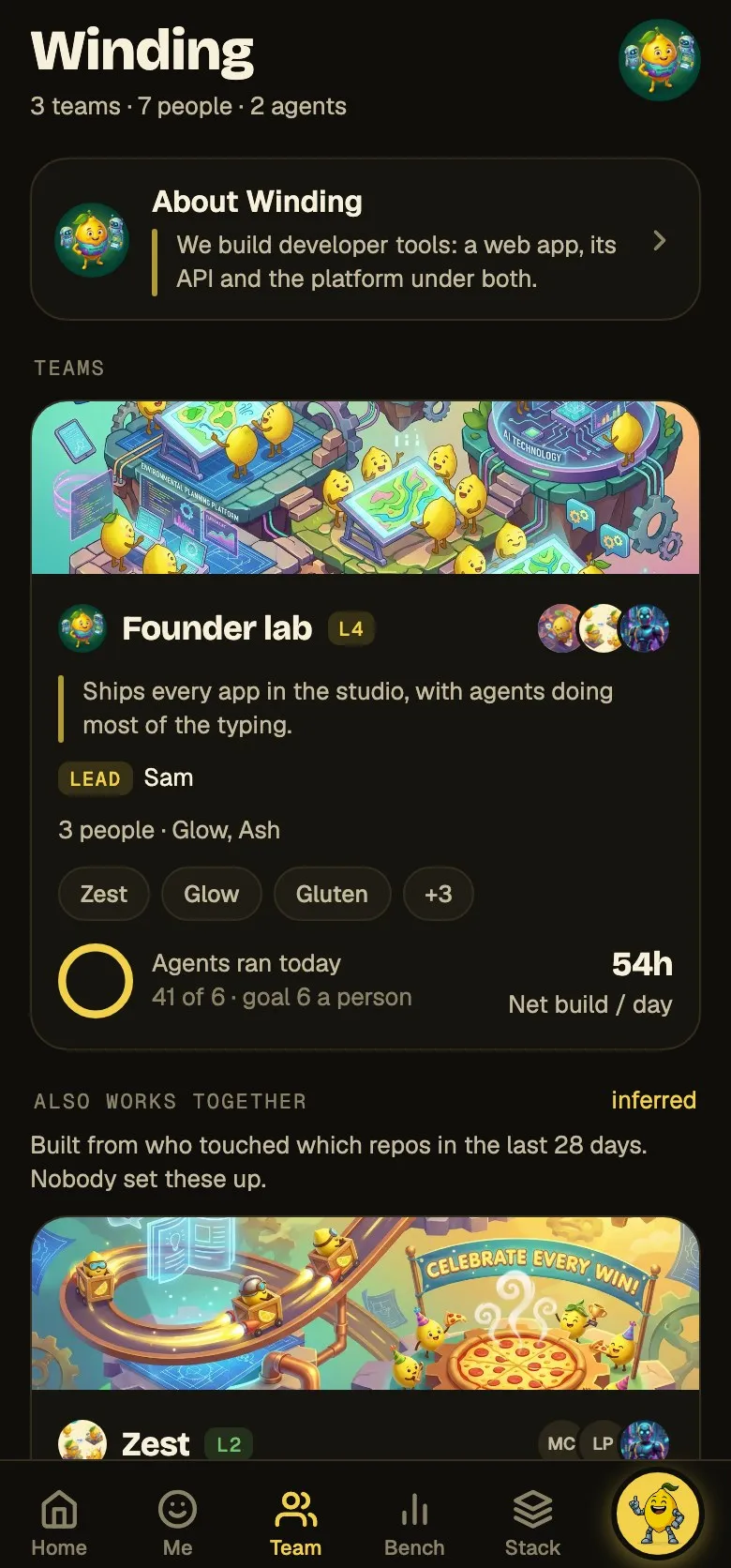
Team in the Zest app: your teams, who's on them and the agent work they ran
USED BY ENGINEERING TEAMS AT
AT A GLANCE
What Weave scores and what Zest records
What Weave scores and what Zest records
Zest
Weave
Scores each pull request
No: Zest doesn't score or rank pull requests or engineers.
Yes: A model (Silk 1) estimates the hours an expert engineer would need for each PR; Weave says 88% of its scores land within an hour of an expert's estimate.[1][7]
How it reads AI coding
A plugin or extension in each engineer's agent uploads every session: prompts, replies, model, tokens, tools, skills and MCP calls. Cursor's token counts come from Cursor's dashboard, only if the engineer turns that on.
Each tool's API where it has one (Cursor, Copilot), git co-authorship where it doesn't, and activity-window estimates “always labeled as estimated”; per-user cost for Claude Code, Cursor, Windsurf and four other tools.[3] Plugins for Claude Code, Codex and Cursor, installed on each machine, add session, prompt and tool activity, depending on installation and permissions.[4][5][6]
Per-engineer view
Yes: Each engineer's sessions, models, skills and MCP tools, next to their pull requests.
Yes: Pro adds individual and team stats: output, quality and reverts per engineer.[1][2]
Answers questions on demand
Yes: Ask Zest answers questions about the team's sessions and pull requests; the MCP server brings them into your agent.
Yes: Wooly, its research agent, answers with sources in the app, in Slack, in your editor or the CLI; an MCP server gives agents the same data.[3][9]
Hosting and code access
Cloud only. The plugins upload session transcripts, never code diffs, after redacting secrets on the laptop; the GitHub App never writes to your code.
SaaS on Google Cloud (us-central1) by default; private cloud or on-prem case by case. It reads pull request diffs to score them.[8]
Cost for 5 engineers
$49/mo for 5 engineers: one Pro workspace, seats included.
$210/mo for 5 engineers: Pro at $42 an engineer a month, billed yearly ($50 monthly).[2]
Free plan or trial
Yes: Starter is free for 3 seats, no credit card.
Yes: Starter is $0, “ideal for basic usage or teams under 5”: output scores, AI ROI and org-level AI, process and quality metrics, with no per-engineer view.[2]
Facts from each vendor's own pages and AWS Marketplace listings, dated in the sources below. ✓ listed, – partly, × not listed on the pages we read, which is not proof the product lacks it.
Workweave is now Weave
workweave.ai redirects to weaveos.com, where the product is called Weave; the app itself still runs at app.workweave.ai. Starter is free, “ideal for basic usage or teams under 5”, with org-level numbers only. Pro adds pull request drill-down, individual and team stats, the Wooly agent and user permissions. Enterprise adds GitHub Enterprise support and custom terms, and private cloud or on-prem hosting is case by case.
How Weave labels its AI numbers
Weave tags each AI number verified (from a tool's API), inferred (from git co-authorship) or estimated (from activity windows). It prices usage per person for seven tools, Claude Code and Cursor among them, and per org for the rest. Its model learns from your team's overrides of its scores, and the scores roll up per engineer.
Weave's plugins for Claude Code, Codex and Cursor record sessions, prompts and tool calls on each machine, depending on installation and permissions. Where PR AI cost is turned on for the organization, Weave adds each prompt's cost to the pull request it worked on, as an estimate in API-equivalent dollars, separate from billed spend.
Zest's numbers come from the session itself, model and tokens included, and like Weave's PR AI cost, Zest's cost per session is a list-price estimate next to the pull request, not your bill. Cursor is the exception: its token counts come from Cursor's usage dashboard, once each engineer turns that on (Cursor usage).
Swarmia: AI cost per person, with no score
Swarmia reads Claude Code, Cursor, Copilot and Codex usage per person from each vendor's API or OpenTelemetry and prices it at token list price, without grading the work. It is free for companies with fewer than 10 developers, and its AI adoption and cost plan is $5 a developer a month, billed annually.
Waydev: cost per pull request instead of hours per pull request
Waydev compares Copilot, Cursor, Claude Code and Windsurf on cost per commit, per pull request and per feature, on Premium at $49 per active contributor, billed annually; Pro, with AI adoption, is $29. Its Enterprise plan runs self-hosted, where Weave's on-prem option is case by case.
LinearB: rules and AI review on each pull request
LinearB acts on pull requests: gitStream rules route reviewers, label and approve small changes, and AI reviews comment on each one. Essentials is $29 a user a month, billed annually, for at least 50 users.
Span: evals on the agent trace
Span judges the session behind the pull request: its laptop agent records Claude Code and Cursor traces, and Span runs evals over them and traces each line of a pull request back to the agent that wrote it. It adds capitalization and surveys, at $45 a contributor a month on a one-year contract.
Jellyfish and DX: for a larger org
Jellyfish measures delivery across Git, Jira or Linear, CI and incident tools, with AI Impact as one module, and sells by quote; its one public AWS bundle is $30,800 a year for 15 seats. DX pairs survey programs with system data and a laptop daemon that marks AI-written lines. Its AWS listing starts at $15,000 a year.
Zest: sessions, with no score or ranking
Zest is ours. It records each engineer's coding-agent sessions (model, tokens, skills, MCP tools) and links them to the pull requests they led to, and scores no one: the team makes the judgment. Where Wooly answers questions on demand, Zest writes each engineer a standup at 6pm; Ask Zest and the Zest MCP server answer questions too. Starter is free for 3 seats. No DORA, capitalization or PR automation, and GitHub only.
How to choose a Weave alternative
Start from what you use Weave for:
One comparable number per pull request: stay on Weave.
AI cost per person, without a score: Swarmia.
AI tools compared on cost per pull request, self-hosted if needed: Waydev.
Rules and AI review on every pull request, at 50 developers or more: LinearB.
A survey program next to delivery data: DX.
The agent session behind each pull request, without Weave's score: Span's traces or Zest's sessions.
TRY IT ON YOUR TEAM
See what your team ships with AI.
Starter is free (3 seats, no credit card). Pro is $49 a month with 5 seats and Max is $149 a month with 10 seats — priced per workspace, not per engineer, with extra seats at $19 a month. See pricing
Weave's pricing page lists Starter at $0, Pro at $50 per engineer a month billed monthly or $42 billed yearly, and custom Enterprise pricing (checked November 15, 2026).
Is Workweave the same as Weave?+
Yes. workweave.ai redirects to weaveos.com, where the product is called Weave (checked October 5, 2026).
What is the best Weave alternative?+
It depends on whether you want a score per pull request: Swarmia and Waydev measure AI use and cost without grading pull requests, LinearB automates review instead, and Span and Zest record the agent session behind each pull request without Weave's score; Weave's own plugins record sessions too.
Does Weave read source code?+
Yes: its trust center lists pull request diffs or selected repository snapshots, with code retention set by the customer, down to none. It runs on Google Cloud in us-central1, and no data is stored outside the US unless negotiated.






 Zest