Swarmia alternatives: 7 tools, from free plans to daily digests.
Sources last reviewed
The closest Swarmia alternatives are Waydev for more Git hosts and self-hosting, Weave for a score per pull request, LinearB for pull request rules at 50 developers or more, and Zest for a standup per engineer. Swarmia itself is free under 10 developers, and its AI plan is $5 a developer a month.[1]
Both post to Slack every day: Swarmia a team summary of ongoing work, completed stories and working agreements,[2] Zest one standup per engineer from that day's sessions and pull requests. Swarmia reads AI usage from each vendor's API or OpenTelemetry;[3] Zest records it inside the agent.
Zest gets you:
Zest Pro: $49 a month for 5 engineers, seats included. Swarmia, free for 5 engineers: the Free plan covers teams under 10 engineers (read October 5, 2026).[1]
A standup per engineer, written from that day's sessions
Claude CodeFable 5.1 (max) (with fallback)70.4 · Coding Agent Index
CodexGPT-6 Astra (max)67.0 · Coding Agent Index
Muse CodeMuse Spark 1.3 (xhigh)64.2 · Coding Agent Index
Grok BuildGrok 4.5 (high)64.1 · Coding Agent Index
Kimi Code CLIKimi K362.6 · Coding Agent Index
OpencodeGemini 3.8 Flash (high)61.2 · Coding Agent Index
Cursor CLIComposer 2.5 Fast38.3 · Coding Agent Index
Demo setups use current model families. The pairings above are the combinations benchmarked by Artificial Analysis; rankings measure performance, not popularity.
Illustrative daily trends · Other totals: last 30 days. Build Hours: this week, model-estimated activity including overlap; not engineer hours.
USED BY ENGINEERING TEAMS AT
AT A GLANCE
Swarmia and Zest, from the daily message to the bill
Swarmia and Zest, from the daily message to the bill
Zest
Swarmia
A daily message in Slack
Yes: A standup per engineer, written at 6pm in their time zone from that day's sessions and pull requests; Slack or email.
Yes: A daily summary in the team's Slack or Teams channel: ongoing work, completed stories and working agreements.[2]
Working agreements
No: Zest sets no targets; the weekly Team Standup points at review waits and oversized pull requests.
Yes: Teams set numeric targets and habits together, and Swarmia tracks them.[4]
Coding agents it reads
Claude Code, Cursor, Codex, GitHub Copilot Chat, Grok Build and Hermes.
Usage and cost from Claude Code, Cursor, GitHub Copilot and Codex; Devin, CodeRabbit and other agents only from the pull requests, reviews and commits they author.[5][6]
How it reads AI coding
A plugin or extension in each engineer's agent uploads every session: prompts, replies, model, tokens, tools, skills and MCP calls. Cursor's token counts come from Cursor's dashboard, only if the engineer turns that on.
Usage and cost per person from each vendor's API, Claude Code by Admin API or OpenTelemetry and Codex on ChatGPT Enterprise only; AI-assisted PRs from co-author trailers and labels. Cost is “the list price of the tokens”.[3][5][7][8][9]
Hosting and code access
Cloud only. The plugins upload session transcripts (Claude Code's with file diffs) after redacting secrets on the laptop; the GitHub App never writes to your code.
SaaS on Google Cloud in Frankfurt by default, US on request; it reads source code but stores only the size of each change.[10]
Free plan or trial
Yes: Starter is free for 3 seats, no credit card.
Yes: Free for companies with fewer than 10 developers (Standard features except HRIS and Swarmia AI); trials need no card.[1]
Cost for 10 engineers
$144/mo for 10 engineers: one Pro workspace, 5 seats included and 5 added at $19 each.
$50/mo for 10 engineers: AI adoption & cost at $5 a developer a month, billed annually.[1]
Cost for 20 engineers
$334/mo for 20 engineers: one Pro workspace, 5 seats included and 15 added at $19 each.
$100/mo for 20 engineers: AI adoption & cost at $5 a developer a month, billed annually.[1]
Facts from each vendor's own pages and AWS Marketplace listings, dated in the sources below. ✓ listed, – partly, × not listed on the pages we read, which is not proof the product lacks it.
Under 10 developers, start with Swarmia free
Swarmia's free plan has every Standard feature except HRIS integrations and Swarmia AI, for companies with fewer than 10 developers, and its trials need no credit card. Zest's free Starter covers 3 seats. If what you need is delivery and DORA metrics for a small team on GitHub or GitLab, Swarmia's free plan gives you that at no cost.
What each daily message contains
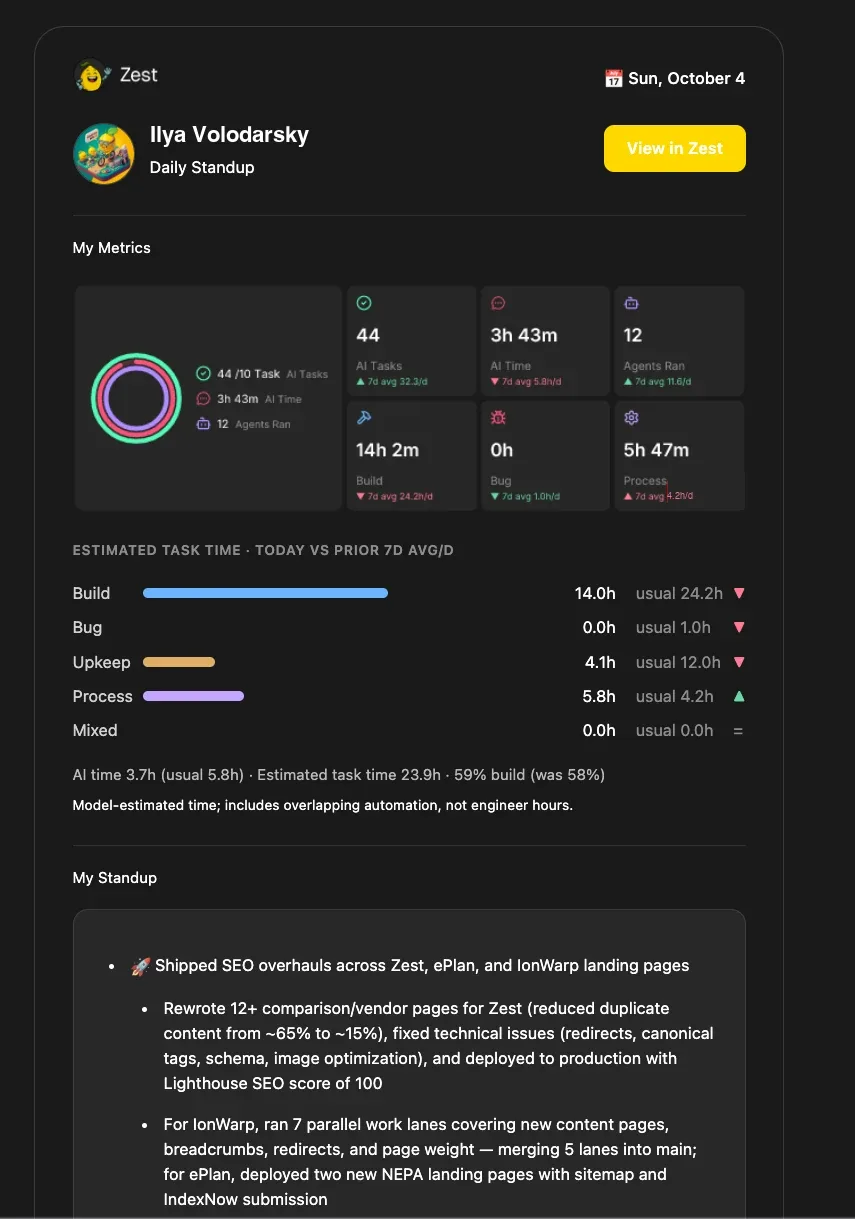
Swarmia's summary goes to a team channel: what is in progress, which stories closed, and how the team is doing against its working agreements. Zest writes one standup per engineer at 6pm in their time zone, from that day's coding-agent sessions and pull requests, in Slack or by email; the workspace owner also gets a weekly digest. More in Slack standup bot.
Zest's daily standup email
Where Swarmia's AI data comes from
Swarmia reads Claude Code through Anthropic's Admin API for API-billed orgs, or through OpenTelemetry from each laptop on Pro, Max, Team and Enterprise plans, with no history backfill. Codex needs ChatGPT Enterprise. A pull request counts as AI-assisted from a co-author trailer, a Made-with: Cursor trailer or a label. Zest's plugin needs no admin key and works on any Claude Code or Codex plan (Claude Code usage).
Swarmia's plans and prices
Swarmia sells each part on its own or bundled, per developer a month, billed annually. Its data sits on Google Cloud in Frankfurt unless you ask for the US.
Swarmia's pricing page, read October 5, 2026
Plan
Per developer a month
Free
Free under 10 developers
AI adoption & cost
$5
Developer surveys
$9
Software capitalization
$18
Productivity & AI impact
$23
Standard
$45
Enterprise
$55
Waydev: per contributor, on more Git hosts
Waydev prices like Swarmia, per contributor and billed annually: AI adoption on Pro at $29, AI impact and DORA on Premium at $49, and a free Start Up plan for 10 repositories. It also reads Bitbucket, Azure DevOps and Gerrit, which Swarmia's pricing page doesn't list, and its Enterprise plan runs self-hosted.
LinearB: working agreements, enforced
Where Swarmia tracks a team against the targets it agreed on, LinearB enforces rules on each pull request with gitStream and adds AI code reviews. Essentials is $29 a user a month, billed annually, for at least 50 users.
Weave: a score for every pull request
Weave reads AI use from tool APIs and git co-authorship, as Swarmia reads vendor APIs and co-author trailers, and adds a model score for each pull request, rolled up per engineer. Starter is free with org-level numbers; Pro is $42 an engineer a month, billed yearly.
Jellyfish, DX and Span: priced by quote
Jellyfish also sells by module (AI Impact, Developer Productivity, DevFinOps), by quote; Gartner's 2026 Magic Quadrant named both it and Swarmia Leaders. DX leads with survey programs where Swarmia sells surveys as a module. Span records whole Claude Code and Cursor sessions on each laptop, where Swarmia reads vendor APIs, at $45 a contributor a month on a one-year contract.
Zest: a standup per engineer, from the agent
Zest is ours. Its plugins (Claude Code, Codex, Grok Build, Hermes) and extensions (Cursor, VS Code) record each engineer's sessions, and Zest writes that engineer's standup from them. It sets no targets: its weekly Team Standup points at review waits, oversized pull requests and phases a cheaper model could run, and leaves the call to the team. Starter is free for 3 seats. No DORA, surveys or capitalization, and GitHub only.
How to choose a Swarmia alternative
Start from why Swarmia doesn't fit:
Under 10 developers on GitHub or GitLab: Swarmia's free plan still fits.
Bitbucket, Azure DevOps, Gerrit or self-hosting: Waydev.
Rules on every pull request, at 50 developers or more: LinearB.
A model score per pull request: Weave.
A survey program at the center: DX.
Each engineer's day, written from their agent sessions: Zest.
TRY IT ON YOUR TEAM
See what your team ships with AI.
Starter is free (3 seats, no credit card). Pro is $49 a month with 5 seats and Max is $149 a month with 10 seats — priced per workspace, not per engineer, with extra seats at $19 a month.
Swarmia is free for companies with fewer than 10 developers. Paid plans are per developer a month, billed annually: AI adoption and cost alone is $5, Productivity and AI impact $23, Standard $45 and Enterprise $55 (checked October 5, 2026).
What is the best Swarmia alternative?+
For Bitbucket, Azure DevOps or self-hosting, Waydev. For rules on every pull request at 50 developers or more, LinearB. For a standup per engineer from their coding-agent sessions, Zest. Under 10 developers, start with Swarmia's own free plan.
Does Swarmia track Claude Code and Cursor?+
Yes: usage and cost per person for Claude Code, Cursor, GitHub Copilot and Codex, read from each vendor's API or Claude Code's OpenTelemetry. Codex needs ChatGPT Enterprise.
Does Swarmia support Bitbucket?+
Not on its pricing page, which lists GitHub (Cloud, Enterprise Cloud and Server) and GitLab (Cloud and Server) only (checked October 5, 2026).

 Winding / Teams






 Zest