
How to Reduce Technical Debt and Win Back Your Time

Alright, let’s be real for a moment. “Technical debt” can sound like a handy excuse developers pull out of a hat when they don’t want to ship a new feature. But it’s a very real thing with very real consequences, a lot like financial debt.
Imagine you’re at a fork in the road. One path is a quick, dirty shortcut to building a feature. The other is a longer, more thoughtful route that builds things the right way. Taking that shortcut is like taking out a loan.
You get the feature out the door on time—a quick win. But now, you’re paying interest. That interest comes in the form of sluggish development, a constant stream of bugs, and a system that’s just plain confusing to work on. Every developer who has to touch that messy code from now on pays a piece of that interest.
What Is Technical Debt and Why Does It Matter
This isn’t just about a few lines of sloppy code. We’re talking about the snowball effect of rushed architectural decisions, ancient dependencies you’re afraid to update, and a glaring lack of automated tests.
Think about a startup that moves at a breakneck pace to win over its first customers. It works, for a while. But fast forward six months, and the engineering team is spending all its time putting out fires and patching security holes instead of building what’s next. That’s technical debt calling in its marker.
This problem has gotten so big that developers are sinking a massive amount of their time just managing the fallout. We’re seeing developers spend anywhere from 25% to 50% of their coding time wrestling with technical debt. That can drag down a team’s development speed by as much as 40%. If you want to dig deeper, you can find more insights about how technical debt is evolving in recent industry analysis.
Technical debt is the invisible force that makes simple changes take weeks instead of hours. It’s the reason your team feels like they’re running in mud, even when working hard.
Breaking Down the Different Types of Debt
To actually get a handle on technical debt, you have to know what you’re looking at. It isn’t just one big, scary monster; it’s a collection of different issues, and each one needs its own game plan.
Here’s a quick rundown of the most common types of debt you’ll find in the wild.
| Debt Type | Description | Developer Example |
|---|---|---|
| Code Debt | This is the classic stuff: messy functions, duplicated logic, and “code smells” that make the codebase a nightmare to navigate. | A 500-line function that does ten different things, with no comments to explain any of it. |
| Architectural Debt | This is the big, systemic stuff. It happens when early design choices don’t scale or fit the product’s new reality. | A monolithic backend that’s now so tangled it’s nearly impossible to update, when it should have been broken into microservices long ago. |
| Testing Debt | This is what you get when you skip writing automated tests to ship faster. The time you “save” is quickly lost to manual regression testing and fixing bugs that pop up unexpectedly. | Pushing a new API endpoint live without any unit or integration tests to verify it works as expected under different conditions. |
| Documentation Debt | This happens when knowledge lives only in people’s heads. When code, architecture, or setup steps aren’t written down, every new person has to relearn everything the hard way. | The only person who knows how the deployment process works leaves the company, and nobody can figure out how to release a critical fix. |
Recognizing which type of debt you’re dealing with is the first step. After all, you can’t fix a problem you can’t define.
Shining a Light on Invisible Technical Debt
You can’t fix what you can’t see. The first real step in tackling technical debt is to drag it out of the shadows—out of obscure server logs and hallway conversations—and put it right in front of the team. This is all about making abstract code problems tangible and visible.

The fact that it’s often invisible is a huge part of why it gets so out of hand. A 2022 McKinsey study found that technical debt can account for a staggering 40% of a company’s total technology estate. This hidden drag makes it nearly impossible to address because leadership can’t see the direct impact it has on the business. For a deeper dive into how these issues snowball in large organizations, you can check out the full findings on technical debt management.
Let Automated Tools Do the First Pass
The quickest way to get a baseline is to let automated tools do the heavy lifting. Static analysis platforms and even simple linters can be baked right into your Continuous Integration (CI) pipeline. Think of them as your first line of defense, scanning every single commit for obvious problems before they have a chance to merge.
These tools are brilliant at flagging the low-hanging fruit:
- Code Smells: They’ll catch things like functions that have grown way too long, classes trying to do too many things at once, or a tangled mess of conditional logic.
- Complexity Hotspots: You can quickly pinpoint modules with high cyclomatic complexity—the ones that are always a nightmare to test and even harder to maintain.
- Security Risks: They’re great for spotting outdated dependencies with known vulnerabilities or common security gaps like potential SQL injection points.
For instance, you could set up SonarQube in your GitHub Actions workflow. A simple rule could automatically fail any pull request that introduces a function with a cognitive complexity score over 15. This simple check forces a conversation about refactoring right then and there, stopping new debt from accumulating.
Get it All Down in a Debt Registry
Automated scans are a great start, but they don’t understand context. That’s where the team comes in. You need a central place to track all the nuanced issues that only a human would spot. A dedicated Jira project or a simple Trello board works perfectly.
This debt registry becomes your single source of truth.
Now, when a developer spots a shortcut or a questionable design choice during a code review, they don’t just leave a comment and move on. They create a ticket. In that ticket, they describe the problem, where to find it, and—most importantly—the potential long-term pain it could cause.
By logging debt, you turn a passing comment into a trackable work item. It acknowledges a compromise was made but ensures it won’t be forgotten. This simple habit is fundamental to making debt visible and manageable.
Speak the Language of the Business
Finally, none of this matters if you can’t get buy-in from product managers and other stakeholders. To do that, you have to connect the dots between messy code and business outcomes. Technical jargon just won’t cut it outside the engineering team.
Stop saying things like, “The PaymentProcessor module has high coupling and violates the single-responsibility principle.” It means nothing to them.
Try this instead: “If we refactor the PaymentProcessor, we can cut bug-fix time on payment issues by 30%. It will also let us integrate new gateways like Stripe or Adyen twice as fast.”
That translation changes everything. Suddenly, you’re not talking about a technical chore; you’re talking about a strategic advantage. It shifts the conversation from a “nice-to-have” cleanup task to a clear business win, making it much easier to get the time and resources you need.
How to Decide What Technical Debt to Tackle First
Once you’ve managed to get all your technical debt out in the open, you’re usually left staring at a pretty intimidating backlog. The secret isn’t to try and fix everything at once. It’s to stop guessing and start making smart, strategic choices.
A simple but incredibly effective way to do this is with the Technical Debt Quadrant. This framework helps you sort tasks by looking at two things: their impact on the business and how much effort it’ll take to fix them. It’s a game-changer for moving from “overwhelmed” to “in control.”
This isn’t just theory; it’s becoming standard practice. Industry watchers are noting that by 2025, top-performing companies are allocating around 15% of their IT budgets just to pay down technical debt. They’re using methods like the Quadrant to knock out high-impact, low-cost problems first, which frees them up to plan for the bigger, more complex architectural fixes down the road. You can dive deeper into these proactive debt management strategies to see how others are doing it.
Using the Technical Debt Quadrant
This quadrant, which Martin Fowler helped popularize, is brilliant in its simplicity. It splits your technical debt into four buckets, making it crystal clear where you should put your energy to get the biggest bang for your buck.
Here’s what it looks like:
This model helps you differentiate between the “we knew what we were doing” kind of debt (prudent) and the “oops, that got messy” kind (reckless). This distinction leads to much better conversations about why the debt is there in the first place and how you should approach it.
The first place you should always look is the high-impact, low-effort quadrant. These are your quick wins. Think of those nagging production bugs, confusing error messages, or poorly optimized queries that make users and your own team miserable. Fixing these delivers immediate and very visible value.
Your goal is to align refactoring efforts with business needs. By tackling the high-impact, low-effort tasks first, you build momentum and demonstrate the value of paying down debt to the rest of the organization.
Let’s make this real. Imagine your team has two items on the backlog:
- Patch a recurring bug in the checkout flow. It’s causing 5% of users to abandon their carts. This is a clear-cut high-impact, low-effort problem.
- Overhaul a clunky legacy API. The developers hate working with it, but it doesn’t directly impact the customer experience. This one is low-impact, high-effort.
When you frame it this way, the choice is obvious. Fixing the checkout bug directly boosts revenue. The API overhaul is important, for sure, but it can wait for a future sprint. This simple quadrant takes prioritization out of the realm of opinion and turns it into a data-backed decision.
Getting Your Hands Dirty: Practical Ways to Pay Down Tech Debt
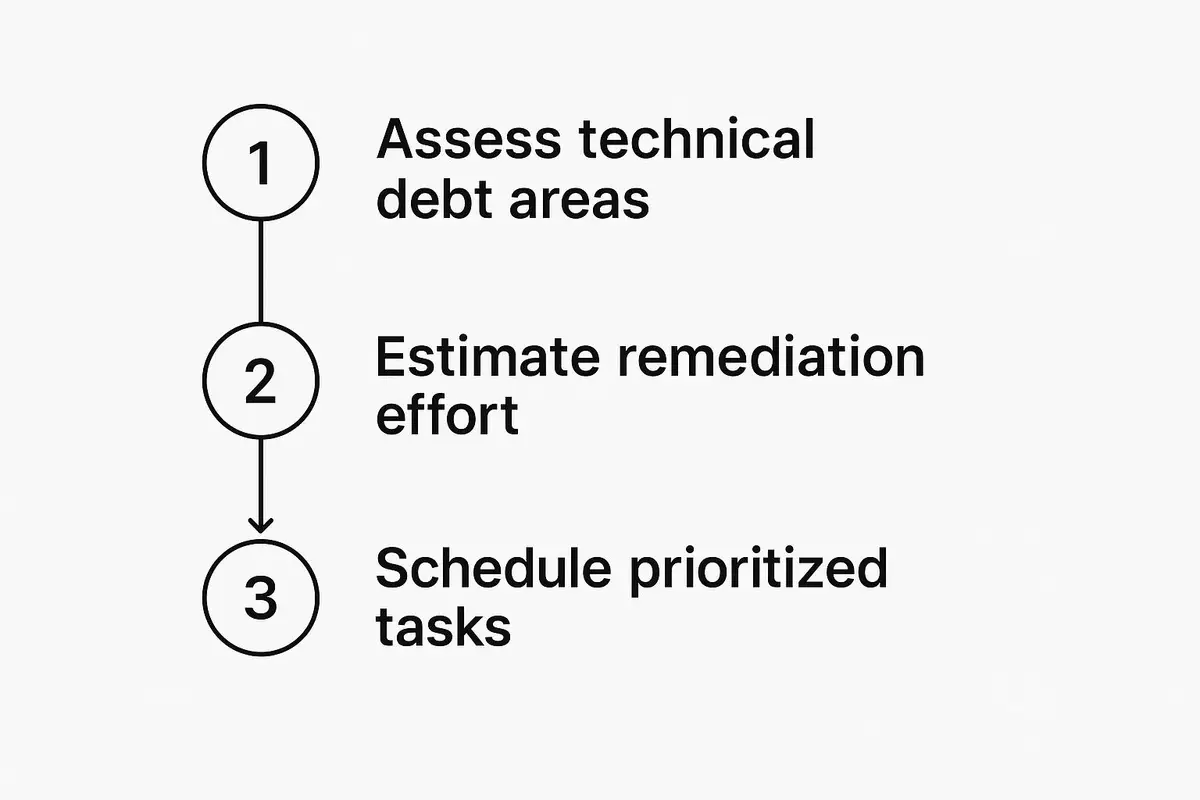
Alright, you’ve identified and prioritized your technical debt. Now for the hard part: actually rolling up your sleeves and fixing it. This is where we move from theory into the day-to-day habits that will systematically chip away at debt without derailing your entire product roadmap.
The secret isn’t some massive, high-risk rewrite. Forget that. The goal is to score small, consistent wins that build momentum over time.

The most successful teams I’ve seen don’t treat this like a one-off project. They make it a cultural norm, weaving debt repayment into the very fabric of their workflow. It becomes a shared responsibility, just like writing new code.
Weave Repayment into Your Daily Workflow
The single most effective way to crush technical debt is to stop seeing it as a separate chore. Instead, you build small refactoring habits right into the work you’re already doing. This simple shift in mindset not only tackles existing issues but also prevents new debt from piling up.
A great place to start is with the “Boy Scout Rule.” The idea is simple: “Always leave the code cleaner than you found it.”
Say you’re fixing a bug or adding a small feature. Just take an extra 10 or 15 minutes to improve the code immediately around your changes.
You could:
- Rename a confusing variable to make its purpose obvious.
- Break a long, winding function into a few smaller, more focused ones.
- Add a quick comment to explain a complex bit of business logic you just deciphered.
These are tiny, low-risk tweaks. But when your whole team does this, the compound effect is enormous. The entire codebase gets healthier with every single commit.
Carve Out Dedicated Time for Refactoring
While the Boy Scout Rule is fantastic for those small, opportunistic improvements, some debt is just too big to tackle in a spare 15 minutes. This is where you need to get intentional and dedicate focused time to refactoring.
Booking this time sends a powerful message: we take code quality seriously. It stops engineering tasks from getting endlessly bumped in favor of the next shiny feature.
Here are two popular strategies that work really well:
- The 20% Rule: This is a classic for a reason. Allocate a fixed slice of every sprint—say, 10-20% of your team’s capacity—exclusively to tech debt and refactoring tasks. This creates a steady, predictable rhythm of improvement.
- Refactoring Days: Schedule a full day (or even two) each month where everyone stops feature work. The team swarms on bigger debt items from the backlog. It’s a great way to build focus and a sense of shared ownership over the codebase.
By putting this time on the calendar, you transform debt reduction from a vague “if we have time” wish into a planned, non-negotiable part of your development cycle. It’s an investment, not a cost.
Build a Safety Net with a Test Harness
Before you even think about refactoring a complex or critical piece of legacy code, stop. You need a safety net. Diving in without tests is like performing surgery in the dark—you might fix something, but you have no way of knowing what you broke in the process.
This is where you wrap the code in automated tests. Before you change a single line, write a set of characterization tests. Their job is to document the code’s current behavior, warts and all. They capture what the code does, not what you think it should do.
Once that test harness is in place, you can refactor with confidence. The second you accidentally alter the system’s behavior, a test will scream at you.
A Real-World Refactoring Example
Let’s walk through a classic source of technical debt: a tangled mess of nested if/else statements for calculating shipping costs.
Before (The Mess):
function calculateShipping(order) {
  if (order.country === 'US') {
    if (order.weight < 10) {
      return 5.00;
    } else {
      if (order.isExpress) {
        return 20.00;
      } else {
        return 15.00;
      }
    }
  } else if (order.country === 'CA') {
    // ... more nested logic for Canada ...
  }
  // ... and so on ...
}
This code is brittle, hard to follow, and a nightmare to modify. Want to add a new country? Good luck. A much cleaner approach is to use the Strategy Pattern, pulling the logic for each country into its own dedicated function.
After (Clean and Maintainable):
const shippingStrategies = {
  US: (order) => {
    if (order.weight < 10) return 5.00;
    return order.isExpress ? 20.00 : 15.00;
  },
  CA: (order) => { /* ... Canadian logic ... */ }
};

function calculateShipping(order) {
  const strategy = shippingStrategies[order.country];
  if (!strategy) throw new Error('Unsupported country');
  return strategy(order);
}
Look at the difference. The new version is clean, easy to read, and incredibly simple to extend. Adding shipping logic for Mexico is now as easy as adding a MX function to the shippingStrategies object. You don’t have to touch the core calculateShipping function at all. This is a perfect example of how a small, focused refactoring effort can pay massive dividends in future maintainability.
Building a Culture That Prevents Future Debt
Fixing the tech debt you have now is a great first step. But the real win? It’s stopping the cycle for good and preventing it from piling up all over again. This requires a shift in how your team thinks and works, moving toward a shared, non-negotiable responsibility for long-term code health.
This isn’t just about reactive bug-squashing. It’s about building proactive habits that stop debt from ever taking root. When quality becomes part of your team’s DNA, you create a sustainable codebase that’s a pleasure to work on—not a constant chore.

Automate Your Coding Standards
The easiest way to start is by taking human error and personal coding quirks out of the picture. Set up clear, enforceable standards and let your tools be the bad cop. This isn’t about micromanaging; it’s about creating a consistent, predictable foundation for everyone.
The best way to do this is to integrate automated formatters and linters directly into your CI pipeline.
- Formatters (like Prettier): These tools automatically enforce a consistent style guide on every single commit. This is how you finally end the pointless debates over tabs versus spaces.
- Linters (like ESLint): Linters go a step further. They catch common code smells, potential bugs, and nasty anti-patterns before the code ever gets merged.
When you make these checks a mandatory part of your pull request process, you guarantee that every piece of code hitting your main branch meets a baseline standard of quality. No exceptions.
Elevate Your Code Reviews
Let’s be honest: a code review should be more than a glorified typo-hunt. It’s one of your most critical opportunities for knowledge sharing, mentorship, and architectural oversight. To make reviews truly count, the focus has to shift from superficial style points to the deeper, more impactful questions.
A great code review doesn’t just ask, “Does it work?” It asks, “Is this maintainable? Is it scalable? Does this solution align with our long-term architectural goals?”
Encourage your reviewers to act like guardians of the codebase, looking for things like:
- Architectural Alignment: Does this new code fit cleanly with the system’s design, or is it a one-off hack that creates another silo?
- Readability and Simplicity: Is this code easy enough for a new developer to understand six months from now without a map?
- Test Coverage: Are there enough tests here to give you confidence that this change won’t break something else down the line?
This simple shift transforms reviews from a tedious chore into a collaborative design session where the whole team learns and improves.
Document the “Why” with ADRs
Good code tells you how something works. But great documentation tells you why it works that way. If you want to stop future developers from repeating past mistakes, you have to capture the context behind your most important technical decisions.
A lightweight yet incredibly powerful way to do this is with Architecture Decision Records (ADRs). Think of an ADR as a short, simple text file that documents a single, significant architectural choice.
An ADR usually just needs to cover three things:
- Context: What was the problem we were trying to solve?
- Decision: What specific solution did we choose?
- Consequences: What are the trade-offs and implications of this choice?
For instance, an ADR could explain exactly why the team decided to use a message queue for a specific feature instead of relying on direct API calls. By writing that reasoning down, you give future teams invaluable insight, preventing them from questioning or accidentally undermining a well-considered decision. This practice fosters a culture where everyone feels empowered to push back on risky shortcuts and build for the long haul.
Let’s Talk About Technical Debt: The Tough Questions
When you start talking about technical debt, the same questions pop up time and time again. Let’s tackle some of the most common ones head-on, so your team can get aligned and start making real progress.
Is All Technical Debt Bad?
Absolutely not. In fact, some of it is a smart business move. This is what we call strategic debt—the kind you take on knowingly.
Maybe you need to rush a feature out the door to beat a competitor or validate a new idea with real users. In these cases, taking a shortcut is a calculated risk. The important part is that the decision is conscious, you document it, and you have a plan to circle back and clean it up.
The real villain is the unintentional debt—the kind that quietly accumulates from messy code, rushed fixes, and general neglect. That’s the stuff that really bites you later.
How Can I Convince My Manager to Prioritize This?
This is the big one. The key is to stop talking like an engineer and start talking like a business partner. Your manager doesn’t care about “refactoring the authentication service,” but they absolutely care about the results.
Frame the problem in terms of business impact. Connect the technical issue to things that matter for the company’s bottom line.
Instead of just naming the technical task, try phrasing it like this:
- “If we clean up this module, we can reduce our server costs by 15% because it’s so inefficient right now.”
- “Fixing this will let us ship new login options 50% faster next quarter.”
- “This will cut customer support tickets for login issues in half.”
Use hard data. Pull numbers from your bug tracker, performance logs, or support system. Show, don’t just tell. When you can draw a straight line from messy code to lost money or slow growth, you’ll get their attention.
Refactoring is the art of restructuring existing code without changing its external behavior, done in small, safe steps. A rewrite is a high-risk, all-or-nothing effort to start from scratch. In almost every scenario, disciplined refactoring is the smarter, safer bet.
Ready to turn messy coding sessions into team-wide wins? Zest records your team’s AI coding sessions in Claude Code, Codex, Cursor and VS Code so you can measure and improve how you work with AI. Learn how Zest can help your team ship faster.