
The Core Benefits of Agile Software Development

When you boil it down, Agile software development delivers three massive wins: faster time-to-market, incredible adaptability, and a higher quality product. Instead of a single, high-stakes launch, teams ship valuable software in small, steady pieces, letting them react to change on the fly and work hand-in-hand with customers.
Why Agile Is the New Standard in Software Development
If there’s one constant in the software world, it’s change. Customer tastes change, markets pivot, and new tech appears overnight. The old way of building software—often called the “Waterfall” method—just can’t keep pace. To really get why Agile is now the go-to approach, it helps to see it side-by-side with traditional models, like those explained in this guide to Waterfall and Agile project management.
The Waterfall model is exactly what it sounds like: a rigid, step-by-step cascade. You have to finish one phase completely before the next one can even start—first requirements, then design, then coding, then testing. It’s like building a house; the foundation has to be perfect before you can put up the walls. This demands a massive amount of upfront planning and leaves almost zero room for error or changes. If the market shifts six months into your year-long project? Too bad. You’re stuck building something that might already be obsolete.
The Agile Mindset Shift
Agile flips that entire process on its head. It’s more than just a new workflow; it’s a completely different way of thinking that accepts uncertainty as a given and focuses on delivering value, step by step. Rather than one big-bang release, Agile carves the work into small, digestible cycles called sprints.
At the end of each sprint—usually lasting one to four weeks—the team delivers a small but fully working piece of the product. This creates an incredibly powerful and continuous feedback loop.
The core promise of Agile is simple: build better products, faster, by embracing change. It replaces rigid, long-term plans with a dynamic system of continuous learning and adaptation.
This model fundamentally changes how development works by prioritizing a few key things:
- Customer Collaboration: Stakeholders are part of the process from start to finish, giving feedback on actual working software, not just abstract plans on paper.
- Responding to Change: A new idea or a shift in priorities isn’t a roadblock. It’s an opportunity to make the final product even better.
- Working Software: Progress is measured by what you can actually use, not by how much documentation you’ve written.
By living these principles, teams make sure they’re always building what users truly need. The result is a product that can adapt on a dime, gets to market faster, and is just plain better.
Agile vs Traditional Waterfall at a Glance
This table offers a straightforward comparison of the foundational principles distinguishing Agile from traditional Waterfall development, helping you quickly grasp the key differences.
| Aspect | Agile Development | Traditional Waterfall |
|---|---|---|
| Process | Iterative and incremental cycles (sprints). | Linear and sequential phases. |
| Planning | Adaptive; plans evolve with new information. | Detailed upfront planning; resistant to change. |
| Flexibility | High; changes are welcomed at any stage. | Low; changes are difficult and costly. |
| Feedback | Continuous feedback from customers and stakeholders. | Feedback is gathered only at the end of phases. |
| Delivery | Frequent, small releases of working software. | One single release at the end of the project. |
| Risk | Lower; risks are identified and mitigated early. | Higher; major issues may not surface until late. |
Ultimately, the choice between these two approaches boils down to how much you know—and how much you expect to learn—as you build.
How Agile Boosts Project Success and Reduces Risk
Let’s cut to the chase: one of the biggest reasons teams switch to Agile is that it stacks the deck in favor of success. It’s not just a new set of buzzwords; it’s a framework designed from the ground up to sniff out and squash risk early and often.
Think about the old way of doing things. You spend months—sometimes years—building a product based on an initial plan. By the time you launch, the market has shifted, user needs have changed, and you’ve built something nobody wants. Agile flips that script. By breaking huge projects into small, digestible sprints, you create a constant rhythm of building, testing, and getting feedback.
From Uncertainty to Advantage
When you’re working on something complex, especially with new tech like AI, the initial requirements are really just your best guess. Agile doesn’t just accept this uncertainty; it leans into it. Instead of trying to plan for every possible outcome upfront (a fool’s errand), it uses short development cycles to learn and adapt on the fly.
This constant learning loop is the secret sauce. You catch problems when they’re small and cheap to fix, not after they’ve spiraled into project-killing disasters. This isn’t just a happy accident; it’s proactive risk management baked right into the process.
By making progress visible and testable every few weeks, Agile transforms risk from a hidden threat into a manageable variable. It provides the framework to fail small and learn fast, which is the surest path to succeeding big.
Each sprint is a reality check, making sure you’re still building something that actually delivers value. This relentless focus is what drastically cuts the odds of building the wrong thing.
The Data Behind Agile Success
The numbers don’t lie. When you compare Agile to traditional project management, the difference in outcomes is night and day. Industry data consistently shows that Agile projects have a success rate of around 75%, a significant jump from the 56% seen in traditional, plan-heavy approaches.
It’s no wonder that 71% of companies have adopted Agile methods, and a whopping 86% of software developers say they use them. Even more telling? Nearly 98% of businesses that made the switch report higher project success. For an engineering manager, that means fewer projects that go dark and fail silently, and more small, measurable wins. You can find more insights about agile project outcomes to see the full picture.
This infographic lays it out visually:
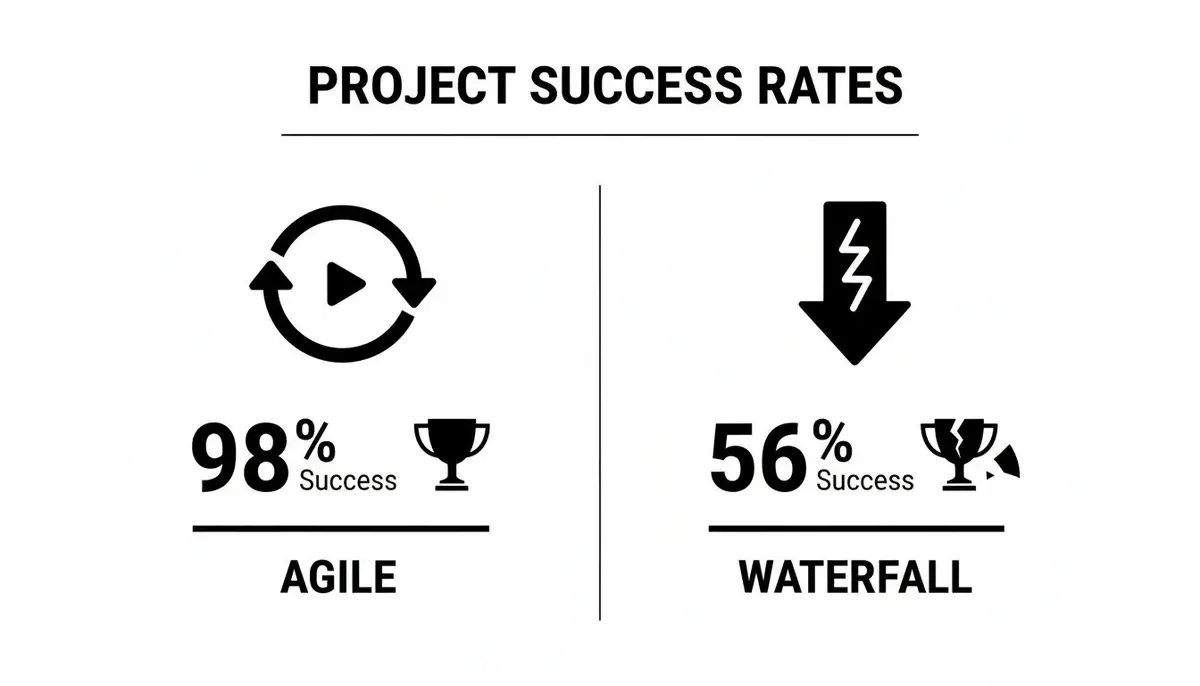
The iterative, feedback-driven core of Agile clearly gives projects a much better shot at hitting their goals.
Making Success Measurable and Repeatable
You can’t manage what you don’t measure. A huge part of reducing risk is making progress tangible. Agile teams don’t just “feel” like they’re on track; they use concrete metrics to prove it.
For example, tracking Velocity—how much work the team actually gets done in a sprint—helps make future planning far more accurate. Monitoring things like Lead Time and Cycle Time shines a light on how efficient your entire process is, from a ticket being created to code being shipped.
These aren’t just vanity numbers for a dashboard. They are essential tools that help teams spot bottlenecks and refine their process, getting more predictable and effective with every single sprint. If you want to get into the weeds of modern engineering metrics, our guide on what DORA metrics are is a great place to start.
6. Ship Faster and Adapt on the Fly
In today’s market, getting your product out the door before the competition isn’t just a nice-to-have—it’s how you win. This is where two of Agile’s biggest strengths come into play: slashing your time to market and giving you the power to adapt instantly.
Think of traditional development like building a ship in a bottle. You have to plan everything perfectly upfront and then work for months, or even years, behind closed doors. Only at the very end do you get to reveal the final product.
Agile completely flips that script. Instead of one massive, high-stakes launch, you deliver working software in small, valuable pieces. You’re not waiting a year to release something; you’re getting a core, usable version into the hands of real customers in a fraction of the time.
This approach centers on a powerful concept: the Minimum Viable Product (MVP).
The Power of the MVP
An MVP isn’t a buggy, half-finished product. It’s the simplest version of your product that solves a real problem for a specific group of users. It has just enough functionality to be useful and attract those crucial early adopters.
The whole point of an MVP isn’t to launch a perfect, all-the-bells-and-whistles product. The point is to learn. By shipping a functional product quickly, you start a conversation with your market right away. This is an absolute game-changer.
Instead of building features based on assumptions in a boardroom, an MVP lets you validate your core ideas with actual, paying customers. The conversation shifts from, “We think our users want this,” to, “Our users are telling us they need this.”
This simple shift dramatically de-risks the entire development process and sets you up to build a product the market actually wants.
How Rapid Feedback Fuels Adaptability
The MVP gets you started, but it’s the rapid feedback loop that keeps the engine of adaptability running. Once your product is live, you start collecting priceless data on how people use it, what they love, and where they get stuck.
This constant stream of feedback is pure gold for a development team. It empowers them to:
- Validate Assumptions: Find out if the problem you think you’re solving is a genuine pain point.
- **Prioritize ays to improve the cycle time meaning for new features and bug fixes.
- Spot Hidden Opportunities: Discover clever or unexpected ways people use your product, which can spark ideas for your next big feature.
- Stop Wasting Time: Quickly abandon ideas that aren’t landing with users, saving hundreds of hours on features no one would have used anyway.
This is what a healthy, data-driven feedback cycle looks like.

Zest links each engineer’s AI coding sessions to the pull requests they led to, so you can act on this feedback with real data.
This cycle of shipping, learning, and iterating is what makes Agile teams so nimble. They aren’t chained to a rigid, year-long plan. They can pivot their entire strategy in the very next sprint based on what the data is telling them.
Turning Speed into Your Secret Weapon
Getting to market faster isn’t just about being first—it’s about being the most responsive. When a new competitor pops up or customer needs change overnight, Agile teams are ready to pounce. Because they work in short, focused sprints, they can re-prioritize their work and start building a solution in weeks, not quarters.
This agility leads directly to real business wins, allowing you to:
- Grab Market Share: By being the first to solve an emerging customer problem.
- Boost Customer Loyalty: By showing users you’re listening and actively responding to their needs.
- Improve ROI: By making sure your development budget is always spent on features that deliver the most value.
Ultimately, the potent combination of faster delivery and continuous adaptation turns software development from a cost center into a powerful engine for innovation and growth.
Improving Product Quality and Stakeholder Collaboration
There’s a common misconception that Agile’s focus on speed means cutting corners on quality. In reality, the opposite is true. One of the biggest wins with Agile is that quality isn’t an afterthought—it’s baked into the process from the very beginning.
Think about the old way of doing things: a massive project gets “finished,” only for the QA team to uncover hundreds of critical bugs just before the big launch. What follows is a frantic scramble of delays and expensive fixes. Agile is designed to prevent exactly that disaster by tackling work in small, manageable pieces.
Quality as a Daily Habit
In an Agile world, quality isn’t a final gate you have to pass through; it’s a daily practice. Instead of one huge testing phase at the end of the line, teams integrate quality checks all the way through the development cycle.
This happens through a few core habits:
- Continuous Integration (CI): Developers merge their code into a shared repository multiple times a day. Every time they do, an automated process kicks off that builds the software and runs a battery of tests, catching conflicts and bugs almost immediately.
- Automated Testing: Teams invest in creating a safety net of tests that run automatically. This ensures that a new feature doesn’t accidentally break something that was already working, giving developers the confidence to move quickly without fear.
- Frequent Code Reviews: Before code is officially added to the project, it’s reviewed by a teammate. This is a fantastic way to catch potential bugs, improve the code’s clarity, and help everyone on the team learn from each other.
By building and testing in these small chunks, bugs are found when they’re fresh and easy to fix. A bug caught five minutes after it was written is infinitely cheaper and faster to resolve than one discovered six months later, hidden under layers of other code.
The Power of Working Together
Agile doesn’t just help you build the product right; it ensures you’re building the right product. This is where close collaboration with stakeholders is non-negotiable. Traditional waterfall projects often keep stakeholders out of the loop until a major milestone, a communication gap that is a notorious cause of project failure.
Agile bridges that gap with a steady rhythm of meetings designed to keep everyone on the same page.
The whole point of Agile collaboration is to get rid of expensive surprises. When you make progress visible and constantly ask for feedback, you ensure the final product actually solves the business problem—it’s not just a flawed interpretation of a year-old requirements document.
Sprint reviews are the perfect example. At the end of every sprint, the team gives a live demo of the actual, working software they just built. This isn’t a PowerPoint presentation with mockups; it’s a hands-on look at tangible progress that stakeholders can react to.
This direct feedback loop is a game-changer. It gives business leaders the power to steer the project as it evolves, making sure every ounce of effort is aimed at creating real value. It cuts down on misunderstandings, slashes rework, and creates a powerful feeling of shared ownership. Practices like pair programming also play a huge role in building this sense of ownership and boosting quality from the inside out.
This tight alignment between the people building the product and the people who need it is what great Agile is all about. It leads to products that don’t just work—they work for the business.
Fostering Team Ownership and Predictable Delivery
Shipping faster is great, but one of the most lasting benefits of Agile is the cultural shift it brings to a team. It moves teams away from top-down micromanagement and toward a system built on trust, autonomy, and a real sense of shared responsibility. This change doesn’t just feel better—it fosters incredible team ownership and makes project delivery far more predictable.

The idea is simple: empower the people closest to the code. Developers, testers, and designers get to make the critical calls about how the work gets done. By giving teams the authority to self-organize and manage their sprint backlog, Agile unlocks a powerful sense of ownership over the final product.
The Power of Empowered Teams
When you give a team the reins to plan their own work, they stop being passive ticket-takers and become active problem-solvers. This shift is huge for both motivation and performance. An empowered team is far more invested in a project’s success because they see a direct link between their decisions and the outcome.
This leads to some serious advantages:
- Motivation Goes Up: When developers feel trusted, they’re more engaged and genuinely driven to produce their best work.
- Accountability Becomes a Team Sport: The team succeeds or fails together. This shared responsibility encourages everyone to help each other out and make sure commitments are met.
- Smarter Solutions Emerge: Autonomy gives engineers the freedom to experiment and find better ways to solve problems, rather than just marching down a pre-defined path.
At its heart, Agile operates on the belief that the people doing the work know best how to do it. This isn’t just a feel-good philosophy; it’s a strategic move that produces higher-quality work and more resilient teams.
When individuals feel like their contributions actually matter, they bring more creativity and commitment to the job. This is where the magic of a self-organizing team really comes to life, turning a group of individuals into a focused, high-performing unit.
Demystifying Delivery with Predictability
For stakeholders and business leaders, one of the biggest headaches with traditional development is its sheer unpredictability. Projects are infamous for blown timelines and last-minute chaos. Agile tackles this head-on by making the entire process transparent and, well, predictable.
The secret sauce here is a concept called velocity. Velocity is a straightforward but powerful metric that measures how much work a team can reliably get done in a single sprint. It’s usually calculated with “story points,” which are just abstract units for estimating the effort a task requires.
By tracking velocity over a few sprints, a team gets a solid baseline of its capacity. This completely changes the forecasting game. For example, if a team consistently completes 30 story points per two-week sprint, you can look at a backlog of 120 story points and confidently predict it will take about four sprints—or eight weeks—to finish.
This data-driven approach pulls planning out of the realm of guesswork and delivers some crucial benefits:
- Timelines You Can Trust: Stakeholders get realistic delivery forecasts they can actually use for their own planning.
- Clarity for Everyone: Anyone can see how much work is being done and how progress is tracking against the plan.
- Smarter Prioritization: With a clear view of team capacity, leaders can make much better decisions about which features to prioritize for the next release.
Zest’s GitHub App tracks pull request throughput and cycle time automatically. This gives engineering managers a clear, real-time picture of their team’s velocity and helps them spot trends or bottlenecks that might throw off future sprints. Ultimately, focusing on predictable delivery builds a strong foundation of trust between the development team and the rest of the business.
How AI Can Supercharge Your Agile Workflow
Knowing the benefits of Agile is one thing. Actually seeing them in your daily work is another challenge entirely. Agile gives you a great framework—iterative progress, quick feedback, and team ownership—but modern AI tools provide the engine to make it all run smoothly.
Think of it like this: Agile is the map, but AI is the real-time GPS that helps you navigate around traffic jams and find the fastest route.
This is where teams make the leap from just “doing Agile” to truly “being Agile.” Instead of just going through the motions of standups and sprints, you can use intelligent tools to get more done. Platforms like Zest are built to close this gap, giving you the data you need to fine-tune your entire process.
Reclaim Your Time by Automating Reports
Daily standups are a classic Agile ceremony, but let’s be honest—they can easily turn into a boring recitation of yesterday’s to-do list. This is a perfect place for AI to lend a hand.
AI Standups take the grunt work out of progress reporting. By analyzing a developer’s actual activity, these tools generate quick, automatic summaries of what got done and what’s blocked. This frees up your team’s precious meeting time to focus on what really matters: solving tough problems and planning the next move.
By automating routine updates, AI gives developers back their most valuable asset: time. It turns the standup from a status report into a genuine problem-solving session.
See Everything with Intelligent Metrics
Predictable delivery depends on knowing what your team can handle and spotting roadblocks before they derail a sprint. But trying to track metrics like sprint velocity or cycle time by hand is a real chore.
AI-powered tools give you a live look into your team’s workflow without the manual effort. This gives engineering managers a clear, up-to-the-minute view of:
- Sprint Velocity: Understand how much work your team can realistically finish.
- Cycle Time: See exactly how long it takes for a task to get from “in progress” to “done.”
- Blockers: Instantly identify where work is getting stuck so you can jump in and help.
This data-first approach takes the guesswork out of planning and makes the whole development process more transparent. If you’re looking for more ways to fine-tune your team’s output, our guide on productivity for developers offers some great strategies that pair well with these insights.
Unblock Your Team and Share What Works
Nothing kills momentum faster than a developer hitting a wall on a tricky problem. Agile is all about moving fast, so cutting down that “stuck time” is essential.
Even better, these tools make it easy to capture and share what’s working. By creating a library of cheatcodes—reusable prompts and smart strategies pulled from real sessions—you can spread the knowledge of your most effective engineers across the whole company. This helps build a culture where everyone is constantly getting better, turning individual breakthroughs into team-wide habits.
A Few Common Questions About Agile
Stepping into Agile for the first time? It’s natural to have questions. Here are a few things teams often ask when they’re getting started.
Isn’t Agile Just for Software Teams?
Not at all. While Agile’s roots are firmly in software, its core ideas have spread far and wide. We’re seeing marketing, product, and even HR teams adopt its principles with great success.
At its heart, Agile is about working in short cycles, getting constant feedback, and being able to pivot when you learn something new. That’s a powerful approach for any team navigating uncertainty, where getting things done quickly gives you an edge.
What’s the Hardest Part of Switching to Agile?
Without a doubt, the biggest challenge is the culture change. Agile isn’t just a new project management template; it’s a completely different way of thinking. It means moving away from rigid, top-down plans toward a system built on collaboration, flexibility, and trust.
For it to work, you need everyone on board—from the newest team member to the CEO. It takes a real commitment to being open, a willingness to learn from small missteps, and a shared focus on getting better over time, rather than just sticking to a plan no matter what.
How Can We Tell If Agile Is Actually Working?
You measure it. The best way to know if your Agile adoption is paying off is to look at a mix of hard numbers and team feedback. These metrics will tell you if you’re truly getting the benefits you hoped for.
Here’s what to keep an eye on:
- Faster Delivery: Is your cycle time dropping? This shows you’re getting ideas into the hands of users faster.
- More Predictability: Is your team velocity—the amount of work you complete each sprint—becoming stable? A steady velocity makes forecasting much more reliable.
- Better Quality: Are you seeing fewer bugs and critical issues pop up after a release? That’s a huge win.
- Happier People: Don’t overlook team morale and customer satisfaction. They are often the clearest signs of a healthy, functioning Agile process.
Ready to stop guessing and start measuring? Zest gives your team the AI-powered insights to see your wins, find what’s slowing you down, and ship faster. Get the data you need to make Agile work for you. See how it works at meetzest.com.