
How Much Do Coding Agents Work Alone? What 810 of Our Sessions Show
Related guide: Claude Code analytics for engineering teams
About a third of the work, in our case. From October 30 to November 12, 2026, our co-founder Ilya Volodarsky ran 810 Claude Code sessions, a median of 58 a day, and the agents logged 968 hours of work. Two in three of those sessions started from a task queue on his phone. They did a third of the agent hours and led to at least 45% of his merged pull requests. The sessions he opened himself were fewer and longer: a median of 10 messages and 86 minutes of agent work each.
Zest records each coding-agent session, links it to the pull request it led to and writes the day's standup, so you can see these numbers for your own team. Start free
These numbers come from Zest, the product we sell, measuring one person on our own team. It is one founder’s two weeks, not a survey.
How we counted
- Source: every session Zest’s Claude Code plugin recorded for Ilya’s account that started between October 30 and November 12, 2026, Pacific time: 900, all in Claude Code.
- Left out: 53 sessions in seven test repositories our own tools use (a made-up product called Widgetly, and scratch folders), and 37 sessions under 10 messages, mostly checks like “Reply with just: ok”. That leaves 810.
- Agent time: for each message on the user’s side, the time until the agent’s last reply before the next one, capped at 3 hours. Waiting for a person doesn’t count.
- User-side messages: prompts, pasted briefs, and the notes Claude Code adds when a background agent finishes. Tool results don’t count.
- Only our own data. Zest’s privacy policy doesn’t say we publish statistics from customers’ data, so we don’t. Every number here comes from Ilya’s account or from Ash, our own agent.
- Counted on November 13, while some November 12 sessions were still running, so a later count comes out slightly higher.
58 sessions a day
The median day had 58 sessions. The quietest was Sunday, November 1, with 6. The busiest was Thursday, November 5, with 110.
The sessions ran side by side. Counting agents at once the way Zest’s levels do, as sessions open at the same moment between their first and last message, the daily peak ran from 6 to 24 and reached 10 or more on 13 of the 14 days.
The 810 sessions logged 968 hours of agent work. Over the 336 hours of the two weeks, that averages almost three agents working at any moment. In practice the work followed Ilya’s day: only 11 sessions started between midnight and 6 a.m.
From first message to last, the sessions were open for 2,130 hours. The agent was working in 45% of that time. The rest, the session was waiting for its next message.
Two in three sessions started from a phone
532 of the 810 sessions (66%) came from Glow, our sister product. Ilya presses Run on a queue of tasks in the Glow app and confirms with Face ID. A runner on his Mac then starts a Claude Code session per task, each in its own git worktree, up to 10 at a time. Tasks for the same repository can go out together as one session, with a note telling the agent to split them across sub-agents.
| Started by | Sessions | Tasks | Median user-side messages | Median agent minutes | Agent hours |
|---|---|---|---|---|---|
| Glow, one task | 323 | 323 | 1 | 20 | 130.4 |
| Glow, several tasks | 209 | 816 | 7 | 37 | 184.5 |
| Ilya himself | 278 | – | 10 | 86 | 653.5 |
The one-task sessions were short and quiet: 168 of the 323 got no message after the brief. Bundles had more user-side messages, and 202 of the 209 used sub-agents. Together, Glow’s sessions did 315 of the 968 agent hours: a third.
The sessions Ilya opened himself did the other two thirds. Nearly all of them begin with his own request, a pasted brief or a screenshot; 6 begin with a brief that another agent or a scheduled job wrote. Their medians were 10 messages and 86 minutes of agent time, and they stayed open about two and a half hours.
Across all 810 sessions, each user-side message was followed by about 9 minutes of agent work. In the sessions Ilya opened himself, it was 11.
The agent nobody starts
Ash Dashwell, our Hermes agent, doesn’t wait for a tap: a schedule starts it. In the same two weeks it ran 42 sessions, on all 14 days: 14 platform usage digests, 14 customer digests, 12 Google Ads checks and 2 scorecard refreshes.
Each run got one message, its job, and the median run took under four minutes of agent time. Where the model was recorded, it was DeepSeek V4 Flash (17 runs) or V4 Pro (7). Zest lists Ash on the Team leaderboard next to the people.
One model, a few skills, a real browser
- Model: Opus 5.5 ran in 801 of the 810 sessions, and 776 used no other model. Fable 5.2 showed up in 16 sessions, Sonnet 5.5 in 13 and Haiku 5.5 in 5.
- Agent: all 810 ran in Claude Code. Ilya used Codex in 409 sessions from May 29 to September 22, and none since.
- Sub-agents: 468 sessions (58%) handed work to sub-agents.
- Files: 625 sessions (77%) edited files. The other 185 changed none.
- Browser: 193 sessions (24%) drove a real browser through Claude in Chrome or Playwright.
- Skills: the Chrome browser skill loaded in 63 sessions, our pull-request skill in 39, code review in 37 and our product-launch playbook in 12.
What shipped
In the same 14 days, 278 pull requests opened from Ilya’s GitHub account were merged, about 20 a day. That’s a floor: Zest sees pull requests only in repositories where its GitHub App is installed, three here, while the sessions started in 21. It also counts some changes twice: 55 of the 278 went into Zest’s production branch, often carrying a change already merged into staging.
187 of the 278 link to a Claude Code session, matched by repository and branch: 126 to a session Glow started and 61 to one Ilya opened himself. The other 91 matched no recorded session. So at least 45% of the merged pull requests came from sessions started from the phone.
Zest wrote Ilya a standup on 13 of the 14 days; Sunday, November 8 had none. Each was nine lines and 240 to 301 words, whether it covered 2 sessions or 83. Nobody reads 83 sessions in a day. Anyone can read 300 words.
What we’d tell another team
- Count agents at once, not just sessions. Ten or more sessions open at once on 13 of 14 days says more about how Ilya works than 58 a day. Zest’s levels use the same count: three or more agents at once on three days is one of the four unlocks for L3 Orchestrator.
- Split sessions by who started them. A queued task and a hands-on session look nothing alike: 1 message and 20 agent minutes against 10 messages and 86. One average hides both.
- Measure agent time, not open time. The agent worked in 45% of the hours the sessions were open.
- Link sessions to pull requests. Without the link, we couldn’t say that 126 merged pull requests came from queued tasks.
We published a longer study of our own pull requests in What 866 agent-written pull requests show. Zest records these numbers for every engineer and agent on a team: Claude Code analytics.
Zest is AI coding analytics for engineering teams: it shows which coding agents, models and skills each engineer uses, what they cost, and which sessions end in merged pull requests. See how Zest works.
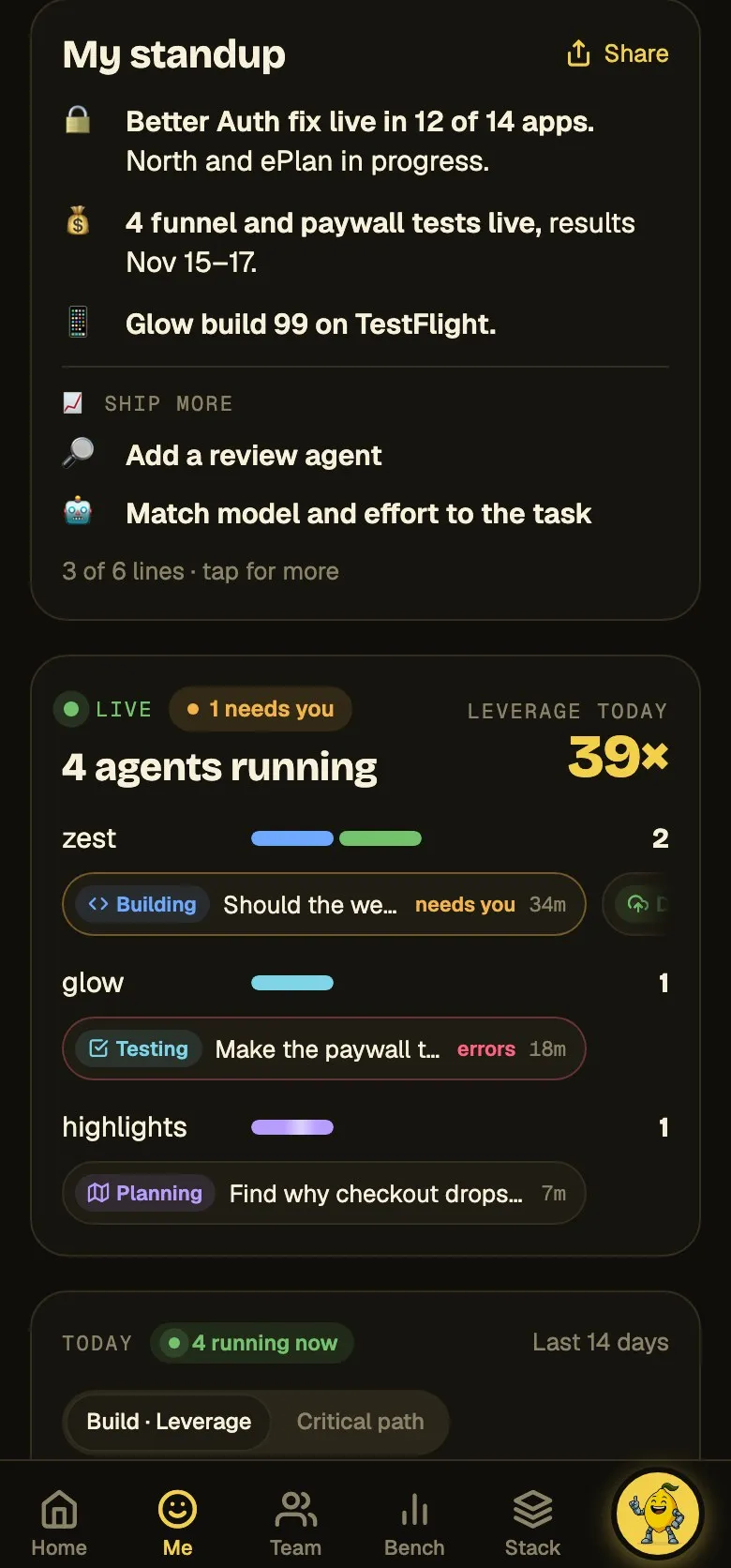
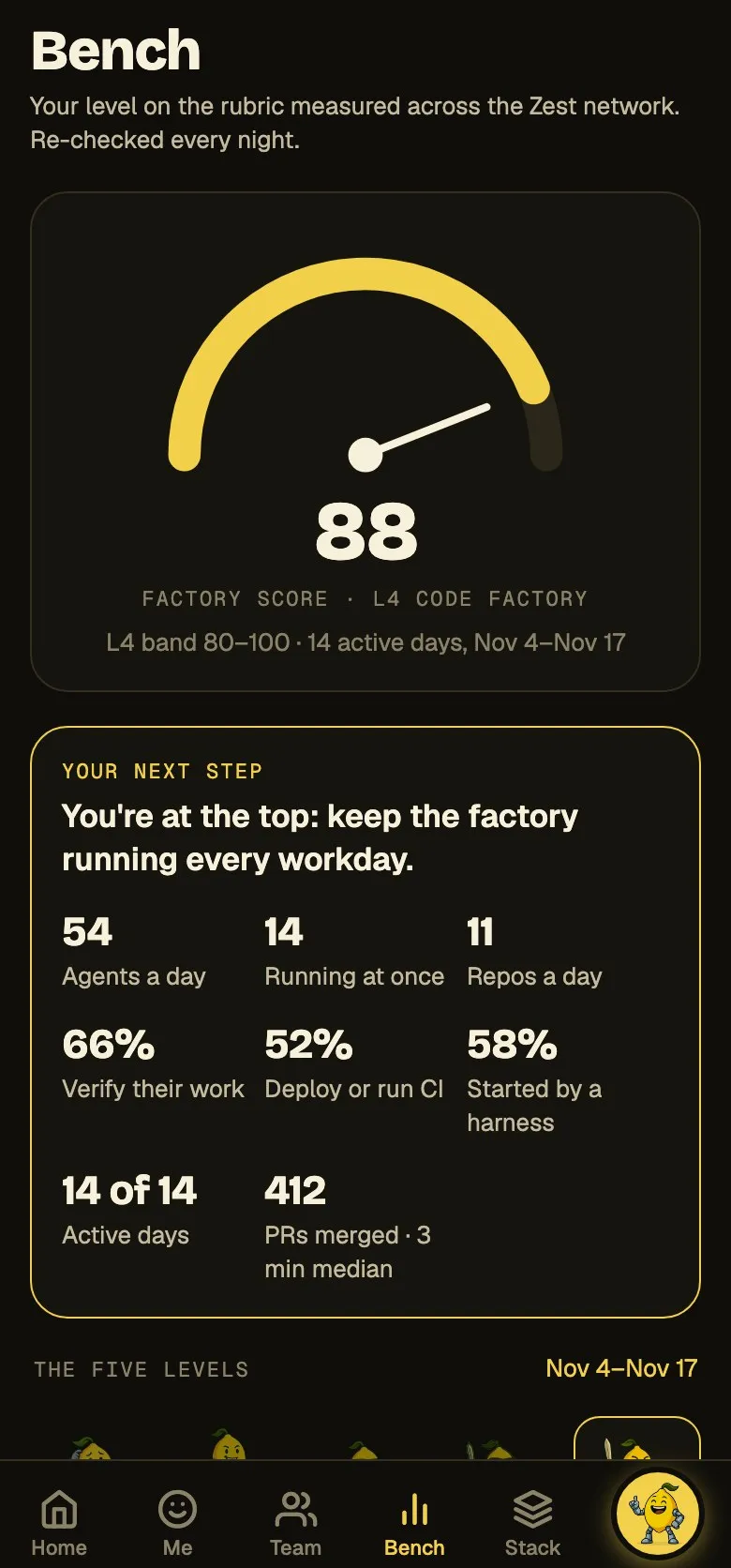
The Zest app