
Sprint Review vs Sprint Retrospective A Clear Comparison
It’s easy to get these two meetings mixed up, but the difference between a sprint review and a sprint retrospective comes down to one simple question: are we talking about the product or the process?
The sprint review is all about the “what”—what did we build? It’s an open-door session to show stakeholders the finished work and get their feedback. In contrast, the sprint retrospective is about the “how”—how did we work together? This is a closed-door, team-only meeting to fine-tune our collaboration for the next sprint.
The Core Difference Explained
Getting these two ceremonies right is non-negotiable if you want to reap the full benefits of agile software development. Think of it this way: the review inspects the car we just built, while the retrospective inspects the assembly line that built it. If you blur the lines, you end up with muddled feedback and lingering team frustrations.
What Is a Sprint Review?
A Sprint Review is far more than a simple demo. It’s a hands-on, collaborative working session where the Scrum Team and key stakeholders get together to inspect the tangible work completed during the sprint.
The whole point is to spark a conversation about the product’s progress and its future. The feedback gathered here directly shapes the Product Backlog, making sure the team stays focused on building what users and the business actually need.
This image perfectly captures the “what vs. how” distinction.
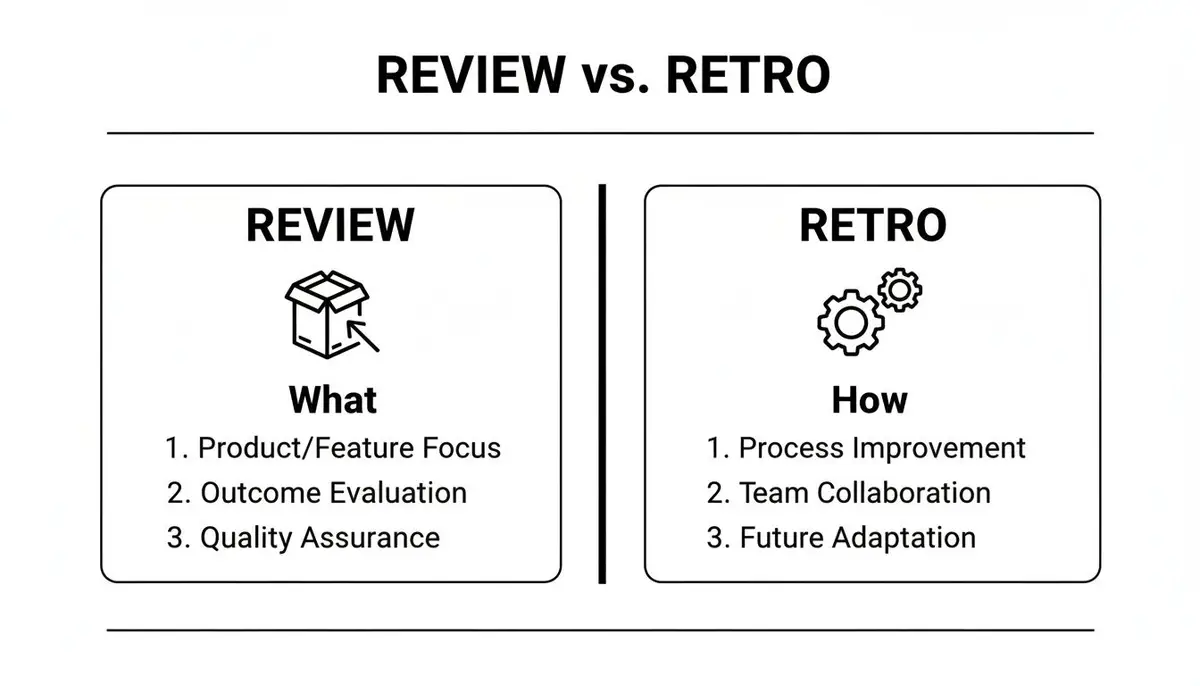
As you can see, the review is laser-focused on product value, while the retrospective zeroes in on making the team’s process better.
What Is a Sprint Retrospective?
The Sprint Retrospective is the team’s private huddle. It happens after the review but before the next sprint planning session, giving the Scrum Team (Developers, Scrum Master, and Product Owner) a dedicated moment to reflect.
This meeting is a safe space to honestly discuss what went well, what stumbled, and what we can learn from it all. The goal isn’t just to talk; it’s to walk away with a concrete, actionable plan to improve how the team works together in the very next sprint. Many teams looking to build this foundation often explore services focused on effective sprint implementation to get expert guidance.
Quick Look: Sprint Review vs. Sprint Retrospective
Here’s a simple table that breaks down the key differences at a glance, helping you keep their distinct purposes clear.
| Attribute | Sprint Review | Sprint Retrospective |
|---|---|---|
| Purpose | Inspect the product increment and adapt the Product Backlog. | Inspect the team’s process and identify improvements. |
| Focus | The “What” — the product itself. | The “How” — the team’s workflow and collaboration. |
| Participants | Scrum Team and key stakeholders (customers, management). | Scrum Team only (Developers, Scrum Master, Product Owner). |
| Timing | At the end of the sprint, before the retrospective. | At the very end of the sprint, after the review. |
| Outcome | A revised Product Backlog and potential release plans. | A small, actionable list of process improvements for the next sprint. |
Ultimately, both meetings are critical feedback loops. One ensures you’re building the right thing, and the other ensures you’re building it the right way.
Why Each Ceremony Has a Different Goal
It’s easy to lump the Sprint Review and Sprint Retrospective together since they both happen at the end of a sprint. But they have fundamentally different missions. Trying to mix them up is like checking a car’s engine by only looking at its shiny paint job—you’re inspecting the wrong thing.
One ceremony looks outward at the product we’re building, while the other looks inward at how the team is building it. Getting this right is critical: the Sprint Review focuses on product inspection, and the Sprint Retrospective centers on process inspection. Each is designed to strengthen a different part of the agile cycle, making sure both the product and the team get better over time.

The Sprint Review: A Product Feedback Loop
The main point of the Sprint Review is to show off the latest product increment and adapt the Product Backlog based on what people think. It’s meant to be a hands-on working session, not a stuffy presentation where the team just talks at the audience. The team demonstrates the value they’ve delivered, turning backlog items into something real that stakeholders can actually react to.
This meeting is all about answering one crucial question: “Are we building the right thing?” Feedback from customers, executives, and other departments isn’t just nice to have; it’s the entire reason for the meeting.
The Sprint Review is the mechanism for inspecting the product. Its mission is to maximize stakeholder feedback to ensure the product vision aligns with market reality and user needs, directly influencing what gets built next.
This feedback is what keeps a project on track. A good review ends with a smarter, more refined Product Backlog filled with fresh ideas, clearer requirements, and reprioritized work based on direct input.
The Sprint Retrospective: A Process Improvement Engine
The Sprint Retrospective, on the other hand, flips the camera around to look at the team itself. Its only goal is to make the team’s process better for the next sprint. It’s a private, team-only affair, designed to be a safe space where everyone can speak frankly about what went well and what didn’t, without pointing fingers.
Here, the team is trying to answer: “How can we build things better?” This isn’t about product features; it’s about the team’s communication, collaboration, tools, and day-to-day workflow.
During a retrospective, the team might dig into:
- Team Dynamics: How well did we work together? Did we communicate effectively?
- Workflow: Did we get stuck anywhere? Were there bottlenecks?
- Tools and Technology: Did our software and tools help us or get in the way?
- Definition of Done: Is our standard for “done” still working for us?
The outcome isn’t a new product plan. It’s a short, focused list of actionable improvements. The team might decide to “block off the first hour of every day for deep work” or “try pair programming on tricky user stories.”
Product vs. Process: Why Separation Is Key
You absolutely have to keep these two meetings separate. When teams try to combine them or let process debates creep into the review, both conversations fall apart. Stakeholders don’t need to get bogged down in the team’s internal friction, and their presence makes it nearly impossible for the team to be truly honest about its struggles.
Think of it this way: the Sprint Review validates the value of what the team built. The Sprint Retrospective improves the efficiency and health of the team that builds it. One steers the ship, and the other tunes the engine. You need both to get where you’re going.
Understanding Who Attends and Why It Matters
Who you invite to a meeting says everything about its purpose. When it comes to agile ceremonies, the difference in attendees for a sprint review vs sprint retrospective isn’t a small detail—it’s what makes each meeting work. One is an open house for product feedback; the other is a closed-door session for the team to get real with each other.
Getting this separation right is non-negotiable. If you invite stakeholders to a retrospective, you kill psychological safety and honesty. If you don’t invite them to a review, the meeting is a waste of time. Knowing who should be in the room is the first step to making both of these events successful.
The Sprint Review: An Inclusive Gathering for Product Feedback
Think of the Sprint Review as an open forum. The core Scrum Team (Developers, Scrum Master, and Product Owner) are the hosts, but the most important people in the room are the key stakeholders.
These aren’t just random colleagues. They are the people who have a direct stake in the product’s success. This group typically includes:
- Customers or End-Users: You need their unfiltered feedback on what you’ve just built.
- Company Executives: They’re there to ensure the work aligns with bigger business objectives.
- Marketing and Sales Teams: They need to see what’s coming down the pike to plan their go-to-market strategy.
- Support Teams: They bring invaluable insights from the front lines about what users are actually asking for or struggling with.
The entire point is to get a conversation going. The team shows off a working product, and stakeholders give their immediate reactions. This back-and-forth is how you inspect what was built and adapt the Product Backlog, ensuring the next sprint is focused on what truly matters.
A Sprint Review fails if it becomes a one-way demo. Its success hinges on creating a collaborative environment where stakeholders feel comfortable asking questions, challenging assumptions, and co-creating the product’s future direction alongside the team.
The Sprint Retrospective: A Private Forum for Team Growth
The Sprint Retrospective is the complete opposite—it’s strictly a team-only affair. The only people who belong in this meeting are the Developers, the Scrum Master, and the Product Owner. No managers, no stakeholders, no exceptions.
This exclusivity is intentional. It creates a pocket of psychological safety where the team can have a raw, honest discussion about their process. To really dig into workflow issues, communication breakdowns, or personal friction, people need to feel they can speak up without fear of judgment or punishment.
The minute an outsider, especially a manager, walks in, the dynamic shifts. People clam up. They won’t admit to mistakes, call out a broken process, or challenge the status quo because they’re worried about how it will make them look.
Let’s look at the numbers. Data from Indeed’s career analysis shows sprint reviews can easily have 10-20 participants and can last up to four hours. Retrospectives, on the other hand, are kept tight, with just the 5-10 core team members. The impact is clear: 80% of high-performing teams keep their retrospectives internal, which correlates to a 25% higher team happiness score.
By keeping the retrospective private, you give the team permission to be vulnerable and constructive. It’s the one place they can safely talk about how they work, which leads to real changes that make the next sprint better for everyone.
It’s crucial to understand that while the attendee lists are distinct, their roles are equally important for the health of the sprint cycle.
Attendee Roles and Responsibilities
Here’s a breakdown of who participates in each meeting and what’s expected of them.
| Role | Sprint Review Involvement | Sprint Retrospective Involvement |
|---|---|---|
| Developers | Demonstrate the completed work, answer technical questions, and gather feedback on the product increment. | Actively participate in discussions about what went well, what didn’t, and how to improve the process, tools, or team dynamics. |
| Product Owner | Presents the sprint goal, explains what was accomplished, and facilitates the discussion with stakeholders to refine the Product Backlog. | Participates as a team member, offering perspective on backlog management, sprint planning, and collaboration with stakeholders. |
| Scrum Master | Ensures the event happens, stays within the timebox, and facilitates collaboration between the team and stakeholders. | Facilitates the meeting to ensure it’s a safe, productive, and positive environment. Guides the team toward actionable improvements. |
| Stakeholders | Actively engage with the demo, ask questions, provide feedback, and collaborate on what to work on next. | Not invited. Their presence can hinder open and honest communication among team members. |
Ultimately, the strict guest list for the retrospective protects the team’s ability to self-organize and improve, while the open-door policy of the review ensures the team is building the right thing for the business. Both are essential.
What Do You Actually Walk Away With? Comparing the Outputs
Once the meetings wrap up and everyone heads back to their desks, what’s left? What tangible results do these two ceremonies actually create? While the outputs from a sprint review vs sprint retrospective are completely different, they’re both absolutely essential. One shapes the future of the product, while the other fine-tunes the team that builds it.
The Sprint Review is all about creating something concrete and forward-looking: a revised and improved Product Backlog. This isn’t just a quick clean-up. It’s a strategic pivot based on candid feedback from the most important people—the stakeholders.

This updated backlog is the direct result of the live demo and the conversations that follow. It’s where new ideas get turned into user stories, confusion gets cleared up, and priorities get shuffled to deliver the most value in the next sprint. You’re essentially watching the product’s roadmap get redrawn in real-time.
The Sprint Review’s Output: A Sharpened Product Backlog
The main goal of the Sprint Review is to produce a clear plan for what comes next. You walk out with an updated backlog that reflects the latest understanding of user needs and business goals.
Typical outcomes include:
- New User Stories: Fresh ideas and feature requests from stakeholders are captured right then and there, ready to be added to the backlog.
- Adjusted Priorities: The Product Owner might reorder items based on the demo and feedback, moving some things up and pushing others down.
- Updated Release Plans: The discussion can easily shift timelines and the scope of future releases, which brings clarity to the whole organization.
- Actionable Feedback: Vague ideas become specific requirements as the team and stakeholders finally get on the same page about upcoming work.
This is exactly why the review is so powerful. It converts a conversation into a concrete plan, making sure the team is always focused on building the most valuable thing next.
The Sprint Retrospective’s Output: A Plan for Getting Better
The Sprint Retrospective, on the other hand, is all about the how. The outcome isn’t a product document but a commitment to action. The team leaves with a short, focused improvement plan that they’ll put into practice in the very next sprint.
This plan is the beating heart of continuous improvement. It takes the team’s honest reflections on their collaboration, tools, and processes and turns them into small experiments designed to make them work better together. A solid improvement plan is the true sign of a mature agile team.
The Sprint Review’s output steers the product’s direction. The Sprint Retrospective’s output upgrades the team’s engine. One ensures you’re building the right thing; the other ensures you’re building it the right way.
These improvement items are usually small but have a huge impact. They aren’t just vague promises; they are specific, actionable tasks that get assigned to team members.
A few examples of retrospective action items might look like this:
- “Let’s refine our Definition of Done to include performance testing.”
- “We’ll dedicate the first 30 minutes every Tuesday to pair programming on tricky tickets.”
- “I’ll create a shared document of common code snippets to help us speed up repetitive tasks.”
These tangible outputs directly boost the team’s health and velocity. While reviews produce the revised backlogs that help 65% of Agile teams hit their deadlines, retrospectives generate powerful action items for process tweaks that can lead to 21% velocity increases over just six months. You can find more insights on how these compare from experts at IC Agile.
Understanding these distinct outputs is crucial for any team trying to master their software development process improvement cycle. The review keeps you aligned with the market, while the retrospective ensures your team is a well-oiled machine, ready to execute on that vision with more efficiency and higher quality every time.
Common Mistakes That Blur the Lines
Even seasoned teams can fall into common traps that blur the lines between a sprint review and a sprint retrospective. When these two meetings start to feel the same, they both lose their punch. Stakeholders get disengaged, and team friction goes unresolved.
The first step to fixing this is learning to spot the anti-patterns. A Sprint Review should never be a one-way presentation, and a Retrospective isn’t a forum for pointing fingers. Each ceremony has a specific job, and keeping them distinct is crucial for a healthy agile process.

Sprint Review Pitfalls to Avoid
The biggest risk for any Sprint Review is losing its collaborative spirit. When that happens, it’s no longer a feedback session—it’s just a performance.
Anti-Pattern 1: The One-Way Demo You know the scene: the team runs through a polished, rehearsed demo while stakeholders watch silently. The meeting ends with some polite applause, but no real discussion. This completely misses the point, which is to get feedback and adapt the Product Backlog.
- Correction: It’s on the Scrum Master or Product Owner to set the right tone. Kick things off by explicitly stating that the goal is to gather feedback, not just show off cool features. Ask open-ended questions like, “How does this feel compared to what you expected?” or “What’s the one thing that seems to be missing for your users?”
Anti-Pattern 2: Stakeholders Skipping Out Key stakeholders are constantly a “no-show,” or they send delegates who don’t have the authority to make decisions. When the right people aren’t in the room, the feedback loop breaks, and the team is left guessing what to do next.
- Correction: The Product Owner needs to constantly reinforce the value stakeholders get from showing up. You can do this by connecting their previous feedback to a specific, positive outcome. Frame the meeting as their best chance to directly influence the product and make sure it meets their needs.
Sprint Retrospective Pitfalls to Avoid
A good Retrospective lives and dies on psychological safety. The moment that’s gone, the meeting becomes a waste of time—or worse, actively hurts team morale.
A Sprint Retrospective is not about assigning blame; it’s about accepting collective ownership of the process. The moment it becomes about ‘who’ did something wrong instead of ‘what’ we can improve, the team stops learning.
Anti-Pattern 1: The Blame Game This is when conversations turn personal. Team members start pointing fingers at each other for failures or delays. It creates a toxic, defensive environment where no one feels safe enough to be honest about mistakes or struggles.
- Correction: The Scrum Master has to facilitate with a firm hand here. Use a structured format like “Mad, Sad, Glad” or “Start, Stop, Continue” to keep the feedback focused on processes and events, not people. It helps to start by reminding everyone of the retrospective “prime directive”: we believe everyone did the best they could with what they knew at the time.
Anti-Pattern 2: Complaining About Uncontrollable Issues The team spends the entire hour venting about things they have zero control over, like company policy, budget cuts, or another department’s priorities. These frustrations are real, but the retrospective isn’t the place to solve them.
- Correction: Try a “Circles of Influence” exercise. Ask the team to sort issues into three columns: things we control, things we can influence, and things we can’t change. Then, you deliberately focus the entire conversation—and all the action items—on just the first two circles.
Anti-Pattern 3: Action Items That Vanish The team comes up with a fantastic list of improvements, but they’re never assigned an owner or tracked. By the next retrospective, the list is forgotten, and the same old problems crop up again. Sound familiar?
- Correction: Make sure every single action item is small, specific, and assigned to one person. Stick to just 1-3 high-impact improvements for the next sprint. Put these commitments somewhere visible, like a shared doc or a ticket in your project management tool.
Frequently Asked Questions
When you’re getting the hang of Scrum, it’s totally normal for questions to pop up about the Sprint Review and Retrospective. They might seem similar at first glance, but they serve very different purposes. Let’s clear up a few of the most common questions teams have.
Can We Just Combine the Sprint Review and Retrospective?
I hear this one a lot, and while it might seem like a way to save time, the answer is a firm no. You really shouldn’t combine them.
Think of it this way: the Sprint Review is a “show-and-tell” for your stakeholders. It’s an outward-facing meeting where you need their feedback on the product. The Retrospective, on the other hand, is a private, “team-huddle” to talk honestly about what went well and what didn’t. Mashing them together kills the psychological safety needed for a good retro. People just won’t be as open with stakeholders in the room.
What if Stakeholders Try to Join Our Retrospective?
This can be an awkward situation, but it’s the Scrum Master’s job to protect the team’s space. They should politely explain that the Retrospective is a closed-door session for the development team to work on its own process.
A good compromise is to offer to share the actionable takeaways or key improvement points with stakeholders afterward. This keeps them in the loop without compromising the team’s safe space. Remember, that safety is what allows for the raw, honest feedback that leads to real improvement.
How Long Should Each Meeting Be?
Both meetings are time-boxed to keep them efficient. A good rule of thumb is to base the timing on your sprint length.
- Sprint Review: Plan on about one hour for every week of your sprint. So, for a typical two-week sprint, block out two hours.
- Sprint Retrospective: A common guideline is 45 minutes for every week of the sprint. That means a two-week sprint gets a 90-minute retrospective.
These are just starting points, not rigid rules. An experienced team might get through them faster, but it’s always better to have the time and not need it than to cut a crucial conversation short.
Does the Product Owner Attend the Retrospective?
Yes, absolutely. The Product Owner is an integral part of the Scrum Team, and their voice is essential in the Retrospective. They aren’t just a guest; they’re an active participant.
They bring a unique perspective on everything from the clarity of user stories to the flow of work from the backlog into the sprint. Without their input, you’re missing a huge piece of the puzzle and can’t truly improve your end-to-end process.