Free for 3 seats · No credit card · One command signs in every agent on your machine
Sample data
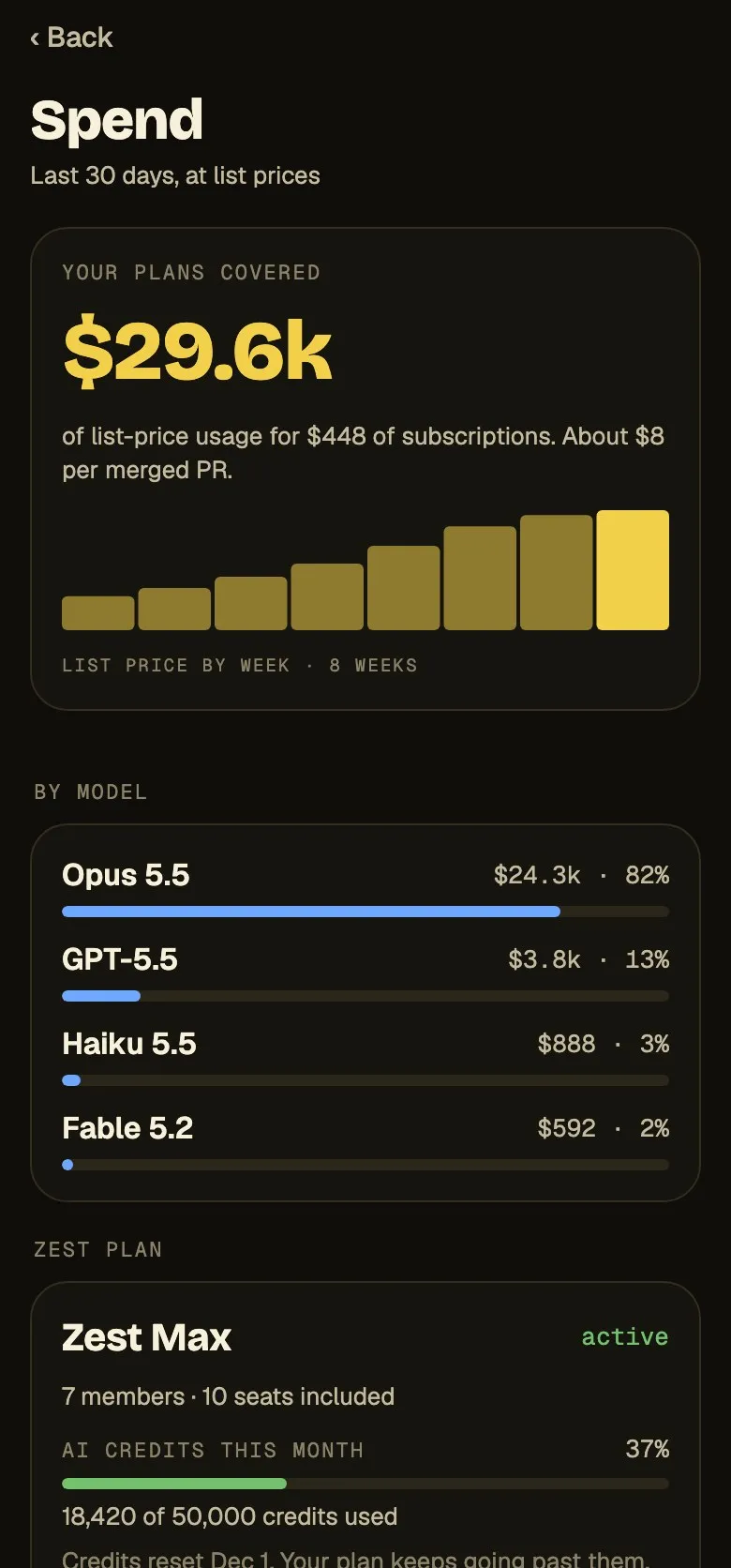
Spend in the Zest app: your agent usage at list prices, by week and by model
USED BY ENGINEERING TEAMS AT
How much does the Claude API cost?
The Claude API costs $0.10 to $8 per million input tokens and $0.50 to $40 per million output tokens, by model. You pay for what you use, monthly, in US dollars, by credit card or (for larger customers) invoice. Haiku 5.5 costs five times more on prompts over 100,000 tokens.
Anthropic API prices per million tokens for the current Claude models, from platform.claude.com. Checked November 21, 2026.
Model
Input
Output
Cache write (5 min / 1 hour)
Cache read
Batch (input / output)
Fable 5.2
$8
$40
$10 / $16
$0.20
$4 / $20
Opus 5.5
$4
$20
$5 / $8
$0.20
$2 / $10
Sonnet 5.5
$2
$10
$2.50 / $4
$0.10
$1 / $5
Haiku 5.5 (prompts up to 100K tokens)
$0.10
$0.50
$0.125 / $0.20
$0.01
$0.05 / $0.25
What does one Claude API request cost?
Multiply each kind of token by its price and add them up. This calculator opens on our own month's average Claude Code request, almost all of it cache reads; change the tokens to price yours:
WORK IT OUT
It opens on our own month's average Claude Code request: 177,130 cached input tokens, 3,486 written to the cache and 878 out.
On Opus 5.5, one request costs $0.0704, and 1,000 a month cost $70.42.
The same request on every current Claude model at list price.
Model
Per request
Per month
Fable 5.2
$0.1054
$105.42
Opus 5.5
$0.0704
$70.42
Sonnet 5.5
$0.0352
$35.21
Haiku 5.5
$0.0132
$13.23
What do common Claude API jobs cost?
A thousand short chatbot replies cost $0.35 on Haiku 5.5 and $14 on Opus 5.5; a thousand 20,000-token summaries cost $100 on Opus. The model and the prompt's size decide most of the bill:
What 1,000 requests cost on each current Claude model at list price, from platform.claude.com's prices. The token counts are our examples, not Anthropic's; only the Claude Code row uses the cache. Checked November 21, 2026.
1,000 requests of
Fable 5.2
Opus 5.5
Sonnet 5.5
Haiku 5.5
Chatbot reply: 2,000 tokens in, 300 out
$28.00
$14.00
$7.00
$0.35
Document summary: 20,000 in, 1,000 out
$200.00
$100.00
$50.00
$2.50
Code generation: 8,000 in, 2,000 out
$144.00
$72.00
$36.00
$1.80
Claude Code turn: our month's average
$105.42
$70.42
$35.21
$13.23
How much did older Claude models cost?
Older models cost the same or more: Opus 5 and Opus 4.5 to 4.8 cost $5 and $25, Opus 4 and 4.1 $15 and $75, Sonnet 4.x $3 and $15. Anthropic keeps them on the API under Additional models. Claude Opus pricing follows the Opus line.
Older Claude models still on Anthropic's API, per million tokens, from the Additional models rows of platform.claude.com's pricing page. Checked November 21, 2026.
Model
Input
Output
Cache write (5 min / 1 hour)
Cache read
Fable 5.1
$10
$50
$12.50 / $20
$0.25
Fable 5
$10
$50
$12.50 / $20
$1
Opus 5, 4.8, 4.7, 4.6 and 4.5
$5
$25
$6.25 / $10
$0.50
Opus 4.1 and 4
$15
$75
$18.75 / $30
$1.50
Sonnet 5
$2
$10
$2.50 / $4
$0.20
Sonnet 4.6, 4.5 and 4
$3
$15
$3.75 / $6
$0.30
Haiku 4.5
$1
$5
$1.25 / $2
$0.10
How does prompt caching change Claude API prices?
A cache write costs 1.25x input for five minutes or 2x for an hour, and a cache read costs 0.05x input on Opus 5.5 and Sonnet 5.5, 0.025x on Fable 5.2 and 0.1x on other models. A five-minute write pays for itself after one read, an hour's after two. Caching is why our $63,936 month would have cost $647,366 without it.
How much does the Claude Batch API save?
The Batch API halves input and output prices for requests processed asynchronously: Opus 5.5 drops to $2 and $10. It stacks with prompt caching, and it isn't available with fast mode or in Managed Agents sessions.
Does Claude's 1M-token context window cost extra?
No: Claude 4.6 and later models bill the full 1M-token window at standard rates, so a 900,000-token request costs the same per token as a 9,000-token one. Haiku 5.5 is the exception, at higher prices on prompts over 100,000 tokens, cache reads and writes included.
What does the Claude API charge on top of tokens?
Fast mode, US-only inference, web search, code execution beyond the free hours, and Managed Agents' runtime. Prompt caching and data residency multipliers stack on top of fast mode.
What Anthropic's API bills on top of tokens, from platform.claude.com's pricing page. Checked November 21, 2026.
Extra
Price
Batch API
Half price on input and output
Fast mode
$8 / $40 on Opus 5.5, $16 / $80 on Fable 5.2 (2x standard)
US-only inference (inference_geo: "us")
1.1x every token price, on 4.6 and later models
Web search
$10 per 1,000 searches, plus the tokens it returns
Code execution
Free with web search or web fetch; otherwise 1,550 free hours a month, then $0.05 an hour
Claude Managed Agents
Tokens at these rates, plus $0.08 per session-hour running
The 1M-token context window
No extra charge on 4.6 and later models, except Haiku 5.5 over 100K tokens
Why is a Claude API bill higher than the price list suggests?
Six things add tokens or multiply the rate:
Thinking bills as output, at five times the input price.
Claude 4.7 and later count about 30% more tokens for the same text.
Every turn of a conversation resends the whole history, cached or not.
Cache writes cost 1.25x or 2x input, and a cache that expires is written again.
Haiku 5.5 prompts over 100,000 tokens cost five times as much.
US-only inference adds 10%, fast mode doubles the rate, and web search bills per search.
Why do newer Claude models count more tokens?
Claude 4.7 and later models use a newer tokenizer that produces about 30% more tokens for the same text, so a per-token price compares fairly only within one generation. Count a prompt with the token counting endpoint and the model's own ID before comparing bills.
Why does output cost more than input, and how is thinking billed?
Output costs five times input on every current Claude model, and thinking counts as output: Claude Code's docs say thinking tokens bill as output tokens. Opus 5.5, Sonnet 5.5, Haiku 5.5 and Fable always think, so a lower effort level is the way to spend less on it.
What does a month of Claude Code cost on the API?
Anthropic puts the average at $150 to $250 per developer a month and about $13 an active day, below $30 for 90% of users. Ours was far heavier: Our own month: 2,228 Claude Code sessions on the Mac that runs our coding agents, October 22 to November 20, 2026, each response counted once and priced at Anthropic's list prices. Every session ran signed in to a Claude plan, so this is what the same work would cost on an API key, not our bill. It is a heavy, agent-run month: 72% of responses came from subagents.
Our Claude Code month, October 22 to November 20, 2026: 2,228 sessions on the Mac that runs our coding agents, priced at Anthropic's API list prices. List price, not our bill. Checked November 21, 2026.
Measured
Value
Sessions and API responses
2,228 sessions, 874,770 responses
Tokens
158.8 billion, 97.6% of them cache reads
Model
Opus 5.5 for 99.1% of tokens
Cost at API list prices
$63,936
The same tokens with no caching
$647,366
Where the cost went
Cache reads 48%, output 24%, cache writes 28%
Median session
$7.25 (59% of sessions under $10)
Median day
$1,806
Days with a usage-limit notice
16 of 30
Is the Claude API cheaper than a Pro or Max subscription?
Only for light use: at Anthropic's average day, $20 of API usage is 2 days of Claude Code. Inside its limits a plan covers far more than its price at list rates, so daily users pay less on Pro, Max or Ultra; Claude pricing has a calculator for your own month. The API suits apps, scripts and batch jobs that run without a person.
Is Claude's API cheaper than OpenAI's?
At the largest and smallest tiers the two cost the same per token; in between, OpenAI's GPT-6.1 Sol and GPT-6.1 Terra cost half of Opus 5.5 and Sonnet 5.5. Google lists Gemini 4 Carbon, its most capable reasoning model, at $2 and $10 per million tokens through November 30, 2026, half of Opus 5.5, and at Opus 5.5's $4 and $20 from December 1. Tokenizers differ, so the same prompt can count differently on each.
Claude and OpenAI API prices per million tokens (input / output), standard tier. Claude's from platform.claude.com, checked November 21, 2026; OpenAI's from developers.openai.com. Checked November 18, 2026.
Tier
Claude
OpenAI
Largest
Fable 5.2: $8 / $40
GPT-6.2 Astra: $8 / $40
Large
Opus 5.5: $4 / $20
GPT-6.1 Sol: $2 / $10
Mid
Sonnet 5.5: $2 / $10
GPT-6.1 Terra: $1 / $5
Smallest
Haiku 5.5: $0.10 / $0.50
GPT-6 Luna: $0.10 / $0.50
Which LLM API costs least per token?
Of the models priced on this page, Haiku 5.5 and OpenAI's GPT-6 Luna, at $0.10 and $0.50 per million tokens; Google lists Gemini 3.5 Flash-Lite, its cost-efficient model, at $0.30 and $2.50. Per token is half the bill: a model that needs two tries, or more output to finish, costs more per finished task.
How do you get a Claude API key, and is any of it free?
Create an account and a key in the Claude Console at platform.claude.com, then buy credits by card on its Billing page. New users get free credits to test the API, and Max, Ultra and Team plans include monthly API credits. Each usage tier caps monthly spend, which rises with your history:
Claude API monthly spend caps by usage tier, from platform.claude.com's rate limits page. Checked November 21, 2026.
Usage tier
Monthly spend cap
Start
$500
Build
$1,000
Scale
$200,000
Custom
None: arranged with Anthropic
Does Claude cost the same on Bedrock, Vertex AI and Foundry?
Amazon Bedrock and Google Cloud's own Claude offering set their own prices, and their regional or multi-region endpoints cost 10% more than global ones from Claude 4.5 on. Claude Platform on AWS and Claude in Microsoft Foundry bill Anthropic's standard rates in Claude Consumption Units at $0.01 each.
Which Claude model should you pick for the price?
Anthropic's pricing page puts Haiku 5.5 on high-volume, latency-sensitive tasks such as classification, extraction and routing, calls Sonnet 5.5 the best combination of speed and intelligence, and positions Opus 5.5 for long-running agentic coding and knowledge work and Fable 5.2 for demanding reasoning and long-horizon agentic work. Sonnet 5.5 costs half of Opus 5.5 per token, and Haiku 5.5 a fortieth on short prompts. Beyond the rate, compare four things on your own prompts: the ratio of input to output, how much of each prompt the cache reuses, how often the cheaper model gets it right first time, and how long each takes to answer.
Claude's four current models per million tokens, from platform.claude.com. Checked November 21, 2026.
Model
Input
Output
Against Opus 5.5
Fable 5.2
$8
$40
2x
Opus 5.5
$4
$20
1x
Sonnet 5.5
$2
$10
0.5x
Haiku 5.5
$0.10
$0.50
0.025x
How do you cut a Claude API bill?
Five levers, biggest first in our own month:
Cache the shared prefix: cache reads are a twentieth of input on Opus 5.5.
Route easy requests to Sonnet 5.5 or Haiku 5.5.
Send work that can wait through the Batch API at half price.
Lower the effort level: thinking bills as output.
Set a workspace spend limit in the Console so a runaway loop stops at a number you chose.
How do you see what each engineer's Claude Code costs?
On an API key, the Console's usage page is the bill; Claude Code's own figures are estimates.
Zest prices every Claude Code session it captures at list rates, inside a plan's allowance too, per engineer, and ties each session to the pull request it led to. Where Claude Code sends the limit meters, on Pro and Max, Zest keeps them with each session, so a lead sees who keeps running out of the five-hour window and sizes each seat to the person.
TRY IT ON YOUR TEAM
See what your team ships with AI.
Starter is free (3 seats, no credit card). Pro is $49 a month with 5 seats and Max is $149 a month with 10 seats — priced per workspace, not per engineer, with extra seats at $19 a month. See pricing
No. A key is free; you pay for the tokens it uses, after any free test credits.
Have Claude's API prices changed recently?+
Yes. In our checks since October: Sonnet 5.5's cache reads fell from $0.20 to $0.10 (seen October 11, 2026), and Fable 5.2 replaced Fable 5.1 at $8 and $40 instead of $10 and $50 (seen November 18).
Does Anthropic discount the API for volume?+
Yes, through its sales team: volume and committed-spend discounts on the API and Enterprise. It doesn't publish the rates.
Does the Anthropic API keep your data?+
Anthropic deletes API inputs and outputs within 30 days by default and doesn't train on them. Longer holds apply to the Files API, chats its safety systems flag (up to 2 years) and legal holds; zero data retention is available by agreement, approved per organization.
Can you self-host Claude to avoid API prices?+
No: Anthropic doesn't release Claude's weights, so self-hosting means running a different, open-weight model and paying for GPUs and operations instead of tokens.
Are reseller prices for Claude cheaper?+
We can't vouch for any. Anthropic's rates are the ones above; it negotiates discounts privately and says figures seen elsewhere may not reflect its pricing.
Are Claude API prices the same outside the US?+
Yes, in US dollars. US-only inference costs 1.1x; global routing, the default, uses standard prices.