Faros AI alternatives: 8 tools, from AI spend control to one team's agent sessions.
Sources checked
The closest Faros alternatives are Exceeds AI and Swarmia for published prices, Jellyfish and Larridin for AI spend across a larger company, Span and Weave for agent sessions tied to pull requests, and Zest for a small team that wants its own sessions. Faros sells by quote: only Faros Desktop, an app for one builder's Mac, is free.[1][2]
Faros, formerly Faros AI, sells a Token Engineering Platform: it connects AI coding spend to the outcomes it shipped, routes each task on evals built from your own code, and keeps usage inside policy, through more than 100 connectors and an optional gateway.[3][4] Zest reads the same sessions from inside each agent and links them to pull requests, but it changes nothing: it routes no model, enforces no budget and sets no policy.
Zest gets you:
Zest Pro: $49 a month for 5 engineers, seats included. Faros: consumption-based, by quote: the Control Plane is “Custom” and Request a custom quote opens a contact form; only Faros Desktop is free (read November 21, 2026).[1]
Sign up and connect GitHub today: no contact form, no demo
Free for 3 seats · No credit card · or run npx @winding-labs/zest
Sample data
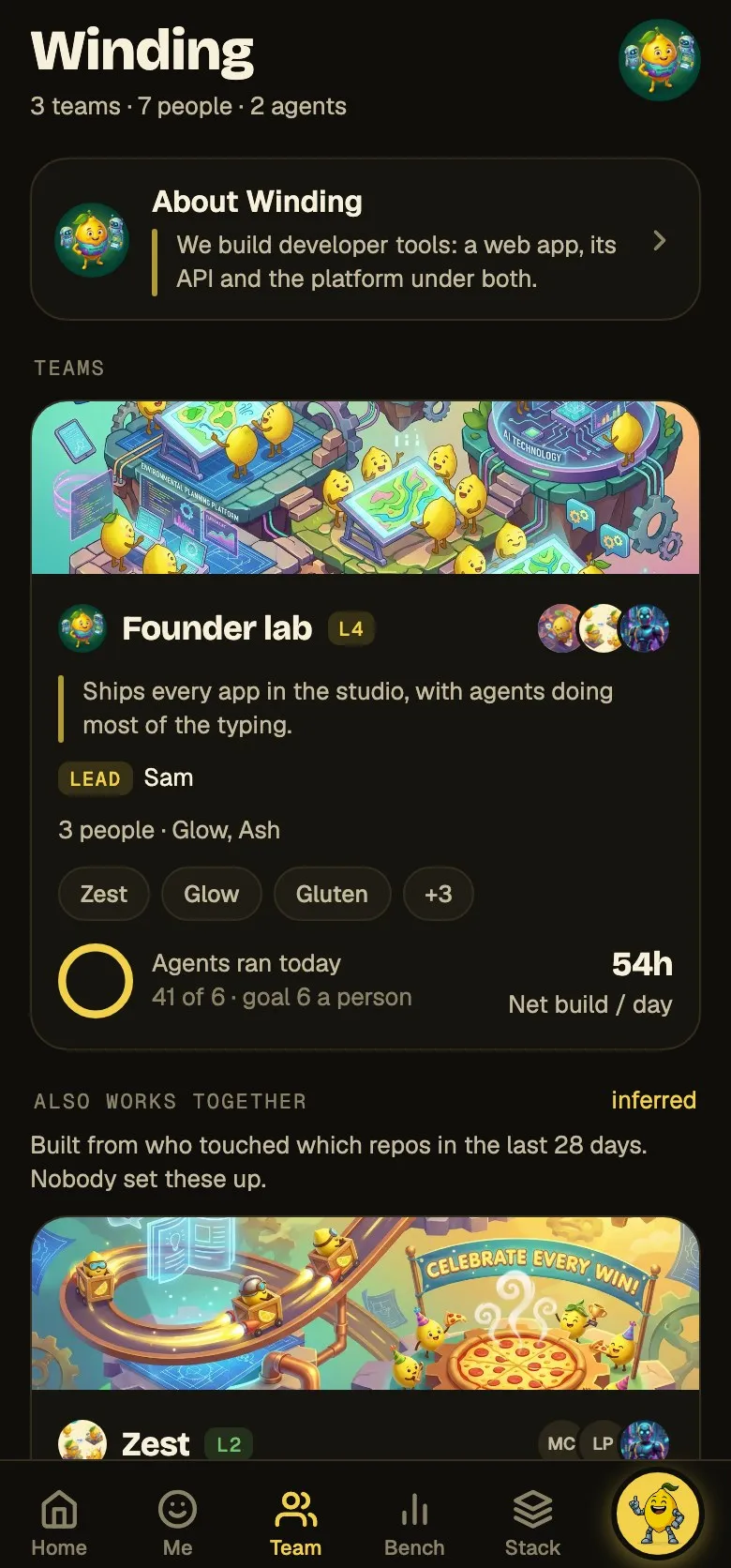
Team in the Zest app: your teams, who's on them and the agent work they ran
USED BY ENGINEERING TEAMS AT
AT A GLANCE
Faros and Zest, from scope to the first invoice
Faros and Zest, from scope to the first invoice
Zest
Faros
What it measures
Each engineer's coding-agent sessions and the pull requests they led to, with a daily standup written from them.
AI coding spend traced to sessions, pull requests, teams and outcomes (cost per outcome), plus engineering metrics such as lead time, change failure rate, rework, PR size and review time.[4][5]
How it reads AI coding
A plugin or extension in each engineer's agent uploads every session: prompts, replies, model, tokens, tools, skills and MCP calls. Cursor's token counts come from Cursor's dashboard, only if the engineer turns that on.
More than 100 connectors, among them Claude Code, Codex, Cursor and GitHub Copilot, plus an optional AI gateway that routes and enforces policy on each model call. Desktop reads session files on each Mac.[2][3][4]
Coding agents it reads
Claude Code, Cursor, Codex, GitHub Copilot Chat, Grok Build and Hermes.
Claude Code, Codex, Cursor and GitHub Copilot; Desktop reads the same four, on macOS only.[2][3]
Answers questions on demand
Yes: Ask Zest answers questions about the team's sessions and pull requests; the MCP server brings them into your agent.
Yes: An MCP server lets Claude, Codex or another MCP-compatible agent query its data in plain language and build dashboards.[5]
Hosting and code access
Cloud only. The plugins upload session transcripts, never code diffs, after redacting secrets on the laptop; the GitHub App never writes to your code.
SaaS, hybrid or on-prem, with customer data staying inside the customer boundary; SOC 2 Type II, ISO 27001 and GDPR.[1][5]
Git hosts
GitHub only, through the Zest GitHub App.
GitHub, GitLab, Bitbucket and Azure DevOps among its connectors.[3]
Free plan or trial
Yes: Starter is free for 3 seats, no credit card.
Yes: Faros Desktop is free to download, with no credit card or login; the Control Plane for an organization is a custom quote. A free Playground shows sample data.[1][2][3]
Cost for 5 engineers
$49/mo for 5 engineers: one Pro workspace, seats included.
Quote only: consumption-based, by quote: the Control Plane is “Custom” and Request a custom quote opens a contact form; only Faros Desktop is free.[1]
Cost for 20 engineers
$334/mo for 20 engineers: one Pro workspace, 5 seats included and 15 added at $19 each.
Quote only: consumption-based, by quote: the Control Plane is “Custom” and Request a custom quote opens a contact form; only Faros Desktop is free.[1]
Facts from each vendor's own pages and AWS Marketplace listings, dated in the sources below. ✓ listed, – partly, × not listed on the pages we read, which is not proof the product lacks it.
When Faros is the better pick
Faros does several things Zest doesn't, and for these buyers it is the right tool:
You have to control AI spend, not only read it. Faros sets budgets and quotas, and its gateway throttles, downgrades or blocks a model request at a cap; Zest reports what each session cost and changes nothing.
You want each task routed to the cheapest model that ships the same work. Faros builds its routes from evals on your own completed work; Zest has no router.
Your data is wider than Git and agents: Jira, SonarQube, PagerDuty and HR systems among more than 100 connectors, and DORA metrics broken down by team, repository, AI tool or model. Zest reads GitHub and agent sessions only.
Security wants SaaS, hybrid or on-prem, with data inside your boundary. Zest is cloud-only.
You use GitLab, Bitbucket or Azure DevOps. Zest is GitHub-only.
What Faros costs, and where it says so
Faros doesn't publish a price for its platform, as of November 2026. Its pricing page calls the pricing “consumption-based”, scaled to your AI usage, size and complexity, and lists two products: Faros Desktop, free, for each builder on their own machine, and the Faros Control Plane, “Custom”, for organizations, behind a request for a custom quote. A free Playground shows illustrative data with no sales call.
Desktop is the only part you can use without talking to sales, and it is for one person on a Mac. A team of 5 that wants a shared view of its coding-agent sessions pays Zest $49 a month on Pro, or nothing for 3 seats.
Faros's price and buying steps, from its own site, read November 21, 2026
Faros
Starting price
Not published; consumption-based, by quote
Free
Faros Desktop, for one builder on macOS; a Playground with sample data
Organization plan
Faros Control Plane, “Custom”
How you start
A custom quote or a demo; the Playground needs no call
Faros Desktop and Zest: where they overlap
Faros Desktop is the part of Faros closest to Zest. It reads Claude Code, Codex, Cursor and GitHub Copilot sessions from the files on your Mac and shows your spend by project, task or model; its FAQ says prompts are never sent to Faros by default. Its figures are API-equivalent list prices, not your bill, and it is for macOS only.
Zest's plugin or extension sits inside each agent, redacts secrets on the laptop and uploads the session text to Zest's cloud, so a team sees everyone's sessions next to the pull requests they led to, and each engineer gets a standup written from them. Pick Desktop if nothing may leave your machine and you work alone on a Mac; pick Zest when several people on different machines need one view, at the price of session text in Zest's cloud. Claude Code analytics shows what that view holds for one team.
Exceeds AI: AI adoption and ROI, priced per manager
Exceeds AI connects to GitHub, GitLab or Azure DevOps with no code changes and says it extracts insights without storing code. Its Pro plan is $65 per manager a month billed annually, or $79 monthly, for up to 50, with a free 7-day pilot. Like Faros it is built around AI adoption and return, but it publishes a price and has a free pilot instead of a sales call.
Swarmia: AI cost per person, with a price list
Swarmia is free for companies with fewer than 10 developers and sells AI adoption and cost on its own at $5 a developer a month, billed annually. It reads Claude Code, Cursor, Copilot and Codex usage from each vendor's API and prices it at token list price, next to delivery metrics.
Jellyfish and Larridin: AI spend across a larger company
Jellyfish puts AI Impact, with token cost management, next to delivery, allocation and finance reports, and sells by quote; its one public AWS bundle is $30,800 a year for 15 seats. Larridin measures AI adoption, fluency and spend in every department, has a router that picks a model for each coding request, and is quote-only. Pick either when the question is the whole company's AI budget, as with Faros.
Span and Weave: sessions tied to pull requests
Span records Claude Code and Cursor sessions with a laptop agent and ties them to pull requests, at $45 a contributor a month on a one-year contract, per Span's comparison pages. Weave has a model score every pull request; its pricing page lists a Teams plan with a Sign up free button and no price. Span's own pricing page asks you to request pricing.
DX: surveys next to the data
DX, now Atlassian's, pairs survey programs with system data from 80 sources and a laptop daemon that marks AI-written lines. Its AWS listing starts at $15,000 a year. Pick it when developer sentiment matters as much as spend; Faros's pages list no surveys.
Zest: one team's agent sessions, without a contract
Zest is ours, and it is much smaller than Faros. A plugin or extension in each engineer's agent records the session, the Zest GitHub App links it to the pull request it led to, and each engineer gets a standup written from the day's work. Starter is free for 3 seats with no credit card; Pro is $49 a month for a workspace of 5, billed monthly.
Its limits: GitHub only, cloud only, closed-source plugins, no code diffs, no DORA metrics, no surveys, no capitalization, no router, no budgets or policy, and nothing outside engineering.
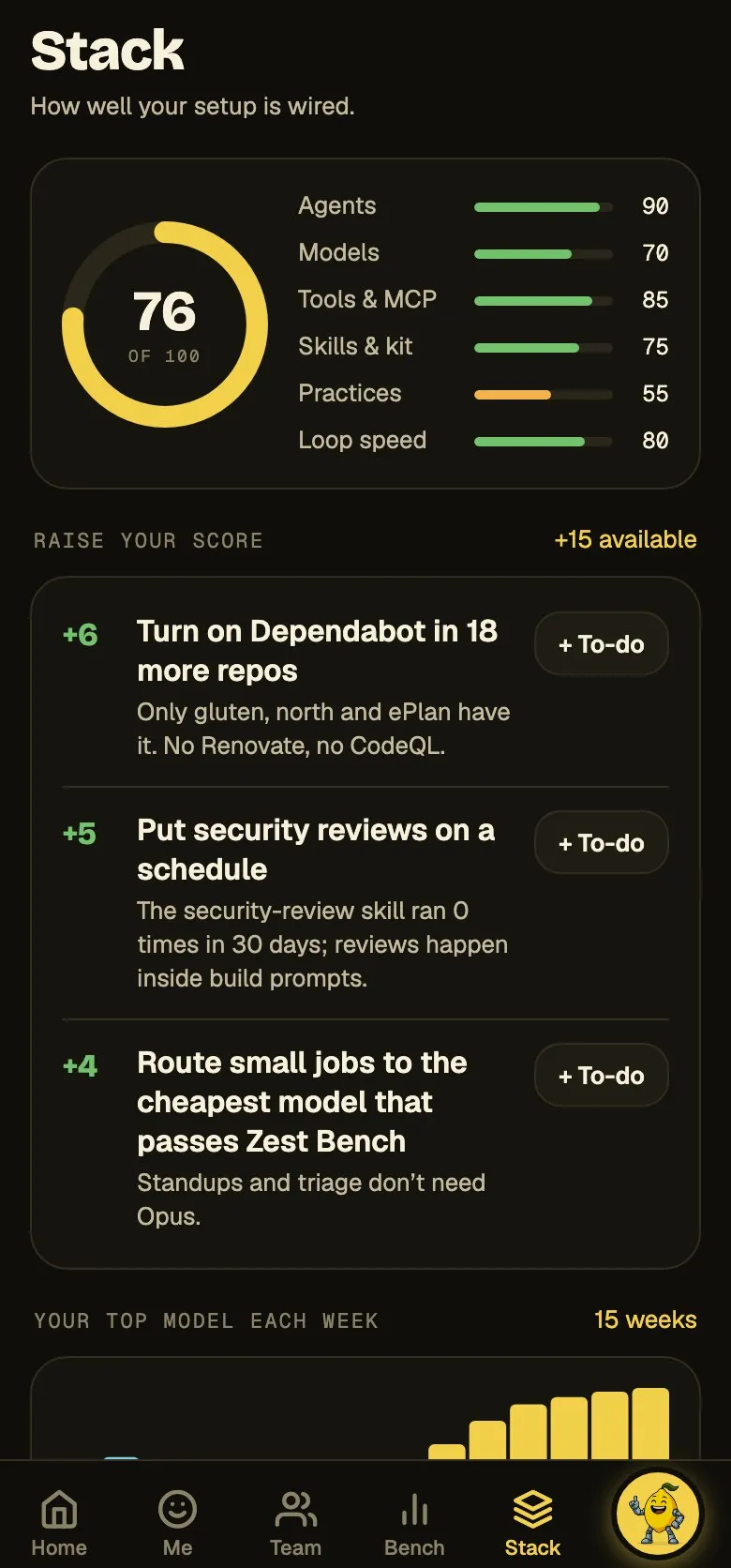
Stack in the Zest app: how well your setup is wired, and what raises the scoreSample data
How to choose a Faros alternative
Start from why Faros doesn't fit:
No published price, or a sales call before you start: Exceeds AI, Swarmia or Zest list a price; Span lists $45 a contributor on its comparison pages.
You want to read AI spend, not enforce it: Swarmia, or Zest for the sessions behind it.
You work alone on a Mac and nothing may leave it: stay on Faros Desktop.
You need the whole company's AI spend and finance reports: Jellyfish or Larridin.
You run a survey program: DX.
You need a gateway, budgets or model routing: stay with Faros.
TRY IT ON YOUR TEAM
See what your team ships with AI.
Starter is free (3 seats, no credit card). Pro is $49 a month with 5 seats and Max is $149 a month with 10 seats — priced per workspace, not per engineer, with extra seats at $19 a month. See pricing
Faros doesn't publish a price for its platform: its pricing page says it is consumption-based, lists the Faros Control Plane as “Custom” and asks you to request a quote. Faros Desktop, for one builder's Mac, is free (checked November 21, 2026).
Is Faros the same as Faros AI?+
Yes. Faros's own FAQ says “Formerly known as Faros AI”, and it now sells a Token Engineering Platform built on its software engineering intelligence data (checked November 21, 2026).
Is Faros Desktop free?+
Yes: one download, no credit card or login, for macOS. It reads Claude Code, Codex, Cursor and GitHub Copilot sessions, and its figures are API-equivalent list prices, not your bill (checked November 21, 2026).
What is the best Faros alternative?+
For a published price on AI adoption and return, Exceeds AI or Swarmia. For AI spend across a larger company, Jellyfish or Larridin. For agent sessions tied to pull requests, Span, Weave or Zest. If you need a gateway, budgets or model routing, none of them replaces Faros.
Does Faros track Claude Code, Codex and Cursor?+
Yes. Its connectors cover Claude Code, Codex, Cursor and GitHub Copilot, and Desktop reads the same four on a Mac (checked November 21, 2026).
Can Faros run on-prem?+
Yes: SaaS, hybrid or on-prem, with customer data inside the customer boundary (checked November 21, 2026). Zest is cloud-hosted only.





 Zest